

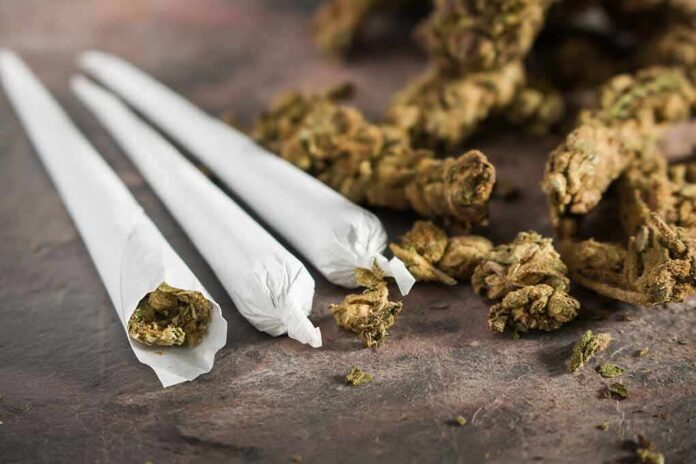
Daily cannabis use among American parents has surged to four times daily alcohol use, and the scale changes family life math.
Story Highlights
- Daily cannabis use among parents rose from 1.3% in 2012 to 5.2% in 2024.
- Parents using cannabis on most days tripled from 2.6% to 8.0% over the period.
- At least 5.9 million children live with a parent who uses on most days, by estimates.
- The trend draws on almost half a million national survey responses.
What changed and how big is the shift
Researchers report a sharp rise in frequent cannabis use among parents across the United States. The share of parents using daily increased from 1.3% in 2012 to 5.2% in 2024, a fourfold jump that stands out against stable or lower daily drinking rates in the same group. A broader measure shows 8.0% of co-resident parents used on the majority of days in 2024, up from 2.6% in 2012. These are population-scale changes, not edge cases.
The estimates come from the National Survey on Drug Use and Health, a large, ongoing federal survey that tracks substance use patterns nationwide. The analysis drew on 481,858 responses collected from 2012 through 2024, which reduces the chance that the observed rise reflects only a niche group or one region. The size and span of the data let researchers compare years cleanly and detect trends rather than one-off spikes.
How many children are in these households
Contemporaneous reporting of the study estimated that at least 5.9 million children lived with a parent who used marijuana on most days in 2024. That figure signals how common this household context has become. It does not prove that a child was present during use or exposed to smoke. A separate study of use episodes found parents reported children were present during use in only a small share of moments recorded. The household count and the exposure context measure different things.
Policy shifts likely set the table for these trends, even if they do not alone explain them. A 2024 intergenerational study found that recreational legalization was linked to higher adolescent use among youth whose parents had used cannabis in their own adolescence, but not among youth without that parental history. That pattern fits common sense: norms travel in families. It also fits conservative values about parental modeling, responsibility, and the need for clear house rules.
Daily use versus daily drinking: what the comparison means
The headline comparison is about frequency, not intoxication equivalence. In 2024, daily cannabis use among parents was about four times daily alcohol use, 5.2% versus 1.3%. The measures do not match dose, impairment, or route. Frequency still matters. Doing anything mood-altering most days can shape routines, sleep, attention, and patience. Parenting draws on all three. The scale of daily cannabis use means everyday family life is where the rubber meets the road, not late-night parties.
– Daily cannabis use among US parents is now 4x more common than daily alcohol use, per new study.
– At least 5.9 million kids live with a parent using marijuana most days, with biggest rises among young and lower-income families since 2012.
– Doctors warn of overlooked risks… pic.twitter.com/1ADuSIEKDl— artssboffixial (@artssboffixial) October 22, 2026
Evidence on parenting outcomes remains mixed and calls for precision. A recent systematic review tied legalization to higher adult and parental cannabis use but found unclear links to worse parenting or higher maltreatment, aside from known risks of pediatric accidental exposure. Another study linked parental use to more negative parenting and child behavior problems, but effects shrank when accounting for other risks. Nationwide child maltreatment data show no overall rise after legalization and even declines in physical abuse reports. These results argue for targeted guardrails, not panic.
Practical takeaways for families, schools, and policymakers
Parents set the tone at home. Clear rules about not using when caring for young kids, safe storage to prevent accidental ingestion, and a no-driving-under-the-influence rule are nonnegotiables. Schools and pediatricians should ask simple, nonjudgmental questions about frequency and timing, the same way they do for alcohol. State leaders can tighten child-proof packaging, improve public education on impairment windows, and crack down on marketing that targets youth, all while respecting legal adult choice.
Researchers can close key gaps fast. First, publish full methods and subgroup results to show how age, sex, income, and state laws interact with parent use. Second, validate survey self-reports with objective measures in a representative sample. Third, track when and where use occurs relative to children, using time diaries and indoor air sampling, to separate co-residence from exposure. These steps sharpen the picture and guide practical policy rather than broad claims.
The bottom line for busy readers
Frequent parental cannabis use is now common enough to shape daily family life. The share of parents who use daily has quadrupled since 2012, and millions of children live in households where a parent uses on most days. This rise does not by itself prove harm, but it raises everyday questions about timing, storage, driving, and sober caregiving. The conservative test applies: protect kids, set clear standards, and keep policies focused on responsibility and consequences, not wishful thinking.
Sources:
facebook.com, pmc.ncbi.nlm.nih.gov, infobae.com, tandfonline.com, icpsr.umich.edu, onlinelibrary.wiley.com, it-boltwise.de