

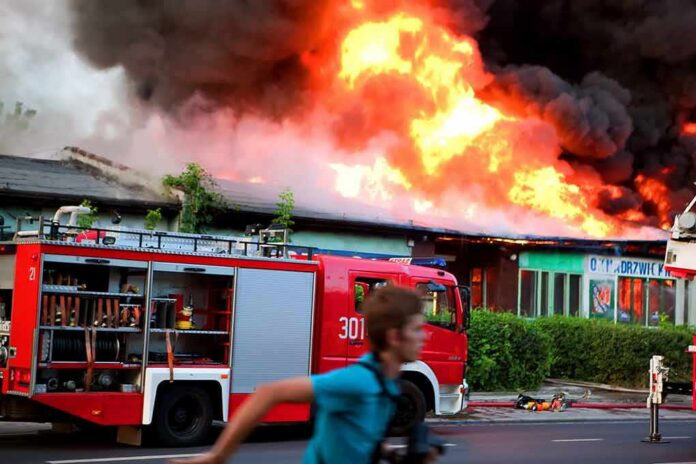
Toledo authorities ordered a one-mile evacuation and a wider shelter-in-place after a late-night chemical release sent a thick haze across North Toledo roadways.
Story Snapshot
- Toledo Fire & Rescue ordered a one-mile evacuation around Progress Avenue after a hazardous-materials release.
- Officials added a three-mile shelter-in-place zone, directing residents to seal homes and turn off outside air.
- Buses and the American Red Cross supported evacuations and sheltering logistics at designated sites.
- Early reports conflicted on the exact facility address as responders worked to identify the substance.
Evacuation And Shelter Orders In North Toledo
Toledo Fire & Rescue ordered everyone within one mile of 1050 Progress Avenue to evacuate at 10:48 p.m. on October 20. City officials tied the order to a hazardous-materials release that spread haze across nearby roads and neighborhoods. Several outlets reported the same one-mile evacuation, confirming the scope and timing. The order emptied homes close to the site while responders set perimeters and began air monitoring and scene control through the night.
By early morning on October 21, officials expanded protective steps with a three-mile shelter-in-place perimeter. Residents were told to stay indoors, close windows and doors, and turn off systems that pull in outside air. The wider zone aimed to limit exposure while crews assessed wind, visibility, and potential irritants in the air. Video from local media showed reduced visibility on several routes as the haze mixed with overnight conditions.
Who Was Affected And How The City Responded
Local agencies set up support for people leaving the area. Shoreland Elementary School served as a temporary shelter, offering a place to wait as conditions changed. Toledo Area Regional Transit Authority buses and the American Red Cross staged at the Meijer lot on Alexis Road to help with transport and basic needs. Washington Township officials joined the effort, with reports noting Raintree Village and the Alexis Addition neighborhood inside the evacuation zone.
Authorities closed roads and managed traffic as the haze thickened near the source. Crews focused on life safety first, then source control, then cleanup. That order of work follows standard hazardous-materials practice during a release. It helps keep people out of danger while teams test the air and secure equipment. The city urged anyone inside the zones to follow instructions until the all-clear was issued.
Facility Identification And Why Decisions Came Fast
Early reports named Sterling Pipe & Tube at 1050 Progress Avenue as the location. Later updates pointed to MC Tank at 1266 Progress Avenue and said the earlier identification was incorrect. Such shifts are common in active incidents as dispatch notes, mapping, and field reports get updated. The key protective steps did not change: move people away from the potential source and reduce exposure downwind until teams confirm details.
Emergency guides explain that officials must choose between evacuation and shelter based on the chemical, amount, release rate, weather, and time needed to move people. There is no one-size-fits-all formula. The federal planning guidance stresses that a protective action zone often extends downwind and that incident commanders may pick larger buffers while facts are still developing. That is why Toledo used a one-mile evacuation and a broader shelter-in-place zone as a safety margin.
What Residents Should Know Going Forward
City alerts emphasized simple steps that cut risk. People in the shelter zone were told to stay inside, seal cracks, and shut off fans that bring in outside air. Drivers were urged to avoid the area due to poor visibility. Those measures are designed to limit contact with airborne irritants while responders contain the source and test the air. Officials said updates would guide when it is safe to return and reopen roads.
A chemical leak late Tuesday night in Toledo, Ohio, prompted a 1-mile evacuation zone while hazmat crews responded to the scene. https://t.co/W6YUtmX2XX
— KIII 3 News (@kiii3news) October 21, 2026
This incident shows how local teams act first to protect health, then refine details as data comes in. The swift setup of shelters, buses, and aid partners helped families who had minutes to move. The conflicting early facility reports reflect the rush of overnight calls, not a lack of action. Clear, steady updates remain vital so residents know when to evacuate, when to shelter, and when normal life can resume.
Sources:
thegatewaypundit.com, cbsnews.com, cleveland.com, thehill.com, yahoo.com, minerva.jrc.ec.europa.eu, cfa.vic.gov.au, fema.gov