

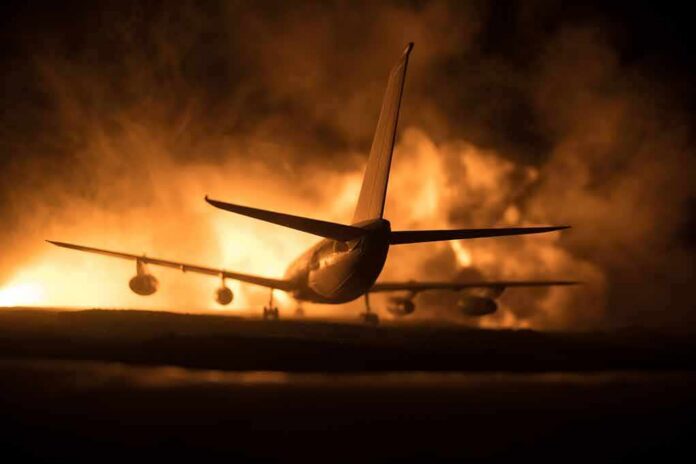
“Plane is on fire” echoed across Miami’s control tower as an Amazon cargo jet barreled off the runway, killing five people and injuring five more.
Story Highlights
- Officials say a Boeing 767-300 cargo plane overran a runway at Miami International Airport, killing five.
- The jet arrived from San Juan, Puerto Rico, as 21 Air Flight 7598, and caught fire after leaving the runway.
- Miami-Dade authorities report five injured, with a large emergency response and airport disruptions.
- Federal investigators are probing a runway overrun, a known aviation hazard that happens several times a year.
What Officials Confirmed About the Crash
Federal Aviation Administration (FAA) officials said a Boeing 767-300 freighter operating as 21 Air Flight 7598 overran the runway after landing at Miami International Airport around 2 p.m. local time on Sunday. The flight departed from San Juan, Puerto Rico. The agency said it will investigate and referred further questions to the airline. Miami-Dade County leaders reported five deaths and five injuries after the aircraft left the runway, struck vehicles, and caught fire.
Local and national outlets reported that the overrun triggered a significant fire and a large emergency response on airport grounds. Officials said the crash affected airport operations, with delays and cancellations following the incident. Authorities held briefings Sunday evening and stated there was no ongoing threat to public safety. Names of the deceased and injured were not released pending notifications to families. Investigators cautioned that the cause will take time to determine under standard procedures.
How a Runway Overrun Happens—and Why It Matters
Runway overruns occur when an aircraft cannot stop on the usable pavement during landing or takeoff. Federal Aviation Administration guidance notes that landing overruns account for about 10 incidents or accidents each year, with severity that can range from minor damage to mass-casualty events. Risk rises when jets touch down long or fast, when runways are wet or contaminated, or when braking action is reduced. Investigators will review weather, touchdown point, speed, weight, and braking data.
Early data points often emerge before investigators finish their work. One analysis cited tracking data indicating the Miami Boeing 767 exited the runway at a high ground speed, which would add stopping distance and energy to any excursion. The National Transportation Safety Board (NTSB) will test that data against cockpit recorders, air traffic control recordings, and physical evidence. That process helps determine if pilot actions, aircraft systems, runway conditions, or a mix of factors played the key role.
Community Impact and a Familiar Safety Challenge
Miami-Dade responders faced a fire, multiple ground collisions, and injured survivors after the jet crossed beyond the runway. Similar events have harmed people on the ground before, especially when an aircraft breaches airport fencing and reaches nearby roads or lots. Airport leaders and local hospitals coordinated to treat the injured and manage traffic. Airlines adjusted schedules as crews worked to secure debris and restore safe operations.
🚨 Miami update: Amazon Prime Air 767 cargo jet overran the runway at MIA Sunday, crossed a road, hit vehicles & caught fire.
💔 5 dead (ground) 🚑 5 injured — 3 critical. Both pilots survived after being trapped.
Plane (21 Air Flt 7598 / N1997A, SJU→MIA) was still ~129 mph… pic.twitter.com/4KErq8y9f4
— SkyBrief (@SkyDocQuest) September 7, 2026
Runway safety has long been a national focus because even rare mistakes can have outsized human costs. Federal and international safety reviews show that runway excursions remain a stubborn risk in both passenger and cargo flying, despite better training, runway design, and braking technology. That reality frustrates families and workers across the spectrum who expect safe, competent management of core infrastructure. People want proof that systems built with public trust and private profit will protect lives.
What Comes Next in the Investigation
Investigators will recover the cockpit voice recorder and flight data recorder, map the touchdown and rollout, and compare crew reports to air traffic control audio. The Federal Aviation Administration will look at airport conditions and runway safety areas. The National Transportation Safety Board typically releases a preliminary report within weeks, with a final report and any safety recommendations months later. Officials urged patience as they build a full picture of what led to this deadly overrun.
Sources:
townhall.com, nytimes.com, aljazeera.com, trtworld.com, ntsb.gov