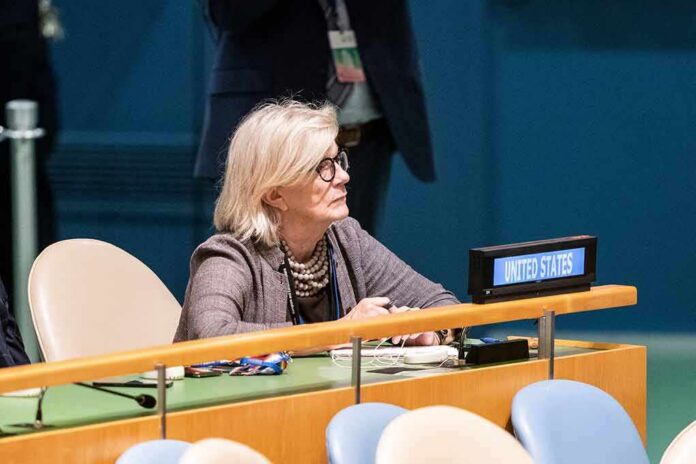
U.S. diplomats walked out as Iran’s president used the United Nations stage to brand America and Israel as “terrorists” and “genocidal,” while denying any nuclear weapons ambition.
Story Highlights
- U.S. delegation exited during Iranian President Masoud Pezeshkian’s speech after accusations against the U.S. and Israel.
- Pezeshkian denied seeking a bomb and claimed a right to “peaceful” nuclear technology.
- President Trump warned at the same gathering that Iran must choose peace or face annihilation if talks fail.
- International watchdog reports show Iran has blocked key nuclear inspections in 2026.
Walkout Meets Tehran’s Accusations at the United Nations
U.S. officials left the hall during Iranian President Masoud Pezeshkian’s address after he accused the United States and Israel of “terrorism” and “genocide.” He held up images and claimed Iran is the victim, not the aggressor. He also said Iran does not seek nuclear weapons, while insisting on an “inherent” right to peaceful nuclear work. The walkout signaled the U.S. rejection of Tehran’s charges and set a hard tone for any talks over war, sanctions, and energy routes.
President Trump spoke earlier at the same United Nations session and warned Iran that the path ahead is simple: make a deal that ends the threat or face annihilation. He said the United States will prevent Iran from getting a nuclear weapon and is ready to rebuild peace if Iran chooses to change course. Trump also told reporters that U.S. and Iranian officials met on the sidelines after his speech, showing pressure and diplomacy now run in parallel.
Iran’s “Peaceful” Claim Collides With Watchdog Findings
Pezeshkian’s claim that Iran wants only peaceful nuclear energy clashes with current reporting from the United Nations nuclear watchdog. The International Atomic Energy Agency said in 2026 that Iran has not provided required information on declared sites and has blocked in‑field verification at almost all facilities. Inspectors reported access only at the Bushehr nuclear power plant, leaving major blind spots across the program. That gap raises urgent questions about stockpiles and hidden work.
Independent nonproliferation analysts who reviewed recent nuclear watchdog reports describe a long pattern of unresolved questions about undeclared materials and activities. Their assessments argue that the degree of noncompliance warrants formal censure and even referral back to the United Nations Security Council if stonewalling continues. Those findings back the U.S. stance that strong leverage is needed to stop Iran from edging closer to weapon capability while denying it in public forums.
Trump’s Strategy: Maximum Leverage, Real Offers, Clear Red Lines
Trump’s message at the United Nations paired pressure with an offramp. He said a deal is possible if Iran changes course, but he also made clear the United States will not let Iran obtain a nuclear weapon. That clarity strengthens deterrence while giving room for talks on ending the war and stabilizing key sea lanes. The contrast with Pezeshkian’s speech was sharp: blame and denial from Tehran versus verification and results demanded by Washington.
🔸 Iran’s UN address and conditions for negotiations:
The U.S. delegation left the UN General Assembly as Iranian President Pezeshkian began his speech.
Pezeshkian said: "No one in this region will have security alone, either we will build it together or we will have to live… pic.twitter.com/DjkLp52Rf6
— Israel RealTime (@IsraelRealtime) September 23, 2026
For American families, the stakes touch energy prices, global shipping, and our troops’ safety. Iran’s rulers want sanctions relief while they restrict inspections at home. That is backwards. Any agreement must restore full access for inspectors, resolve outstanding questions on nuclear material, and end support for terror proxies. Until then, a firm U.S. posture protects our security, our allies, and our economy. The walkout showed America will not legitimize propaganda while facts point the other way.
Sources:
youtube.com, abcnews.com, theguardian.com, thedailybeast.com, isis-online.org