

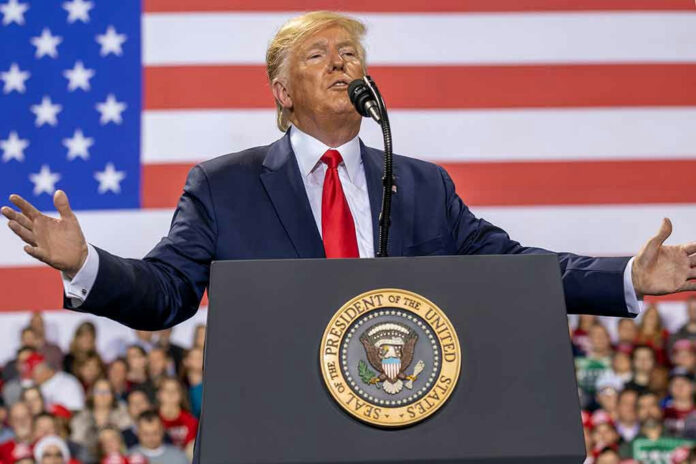
At the last minute, President Trump shelved an artificial intelligence order he believed could slow America’s edge over China—choosing competition over bureaucracy.
Trump Places Competitiveness Over Precaution
President Trump postponed signing a planned artificial intelligence security order after concluding that certain provisions might undercut U.S. leadership. Trump told reporters he “didn’t like” parts of the proposal and warned it could “harm the competition” as the United States pushes to lead the artificial intelligence revolution [3]. He added that America is out in front, with China as the primary challenger, and he would not allow self-imposed restraints to hand rivals an advantage in a critical strategic domain [4].
The administration’s public posture around artificial intelligence has consistently emphasized dominance, not drag. A January 23, 2025 White House action declared it national policy to “sustain and enhance America’s global AI dominance,” revoked prior directives viewed as barriers, and directed an immediate review of Biden-era policies that conflicted with the new approach [2]. This direction, reflected in contemporaneous legal analysis, instructed agencies to suspend, revise, or rescind actions inconsistent with a competitiveness-first framework [1].
Policy Throughline: Minimize Burdens, Maximize U.S. Lead
The December 2025 national artificial intelligence framework reaffirmed the same operating principle: the United States should sustain global dominance while setting a “minimally burdensome national standard” to unify policy and prevent a patchwork that could stall innovation [5]. That continuity suggests the postponement was not an ad hoc reversal, but part of a coherent line placing economic strength, national security competition, and technological deployment ahead of expansive new controls that risked slowing American firms and researchers [5].
Trump’s public comments connected the dots explicitly: he argued that heavy-handed rules risk killing jobs and blunting momentum while adversaries surge ahead [4]. Supporters see that stance as common sense—focus on clear threats and targeted safeguards without shackling builders. They contrast it with earlier approaches that layered mandates across agencies, creating compliance drag and empowering bureaucracies to micromanage fast-moving tools where speed and scale often decide who sets global standards [2].
What We Know—and What We Do Not
Available records confirm a postponement of a planned artificial intelligence order with a cybersecurity focus, not the release of a final text. Media clips capture Trump’s rationale, but the draft itself has not been published, leaving the exact provisions—and their potential costs—unclear [3]. Without the draft language, observers cannot determine whether it targeted narrow risk controls or broader requirements that could have chilled model training, cloud buildout, or enterprise adoption. That evidentiary gap tempers sweeping conclusions about the order’s specific impacts [3].
Trump Says He's Postponing Signing an Executive Order on AI out of Concern It Would Hurt AI Industry https://t.co/eD5Ljrk6vs
— Outspoken_T_From_Tha_Lou (@TRUMPGIRL_STL) May 22, 2026
Even with those limits, the broader policy arc is documentable. The administration’s directives center on removing barriers and aligning agencies behind a dominance-first policy, with explicit instructions to review and unwind conflicting actions from the prior administration [2][1]. The December 2025 framework doubles down on a single national standard with minimal burden—an implicit rebuke to regulatory sprawl that can invite mission creep, suppress investment, and cede the field to foreign competitors who do not share American constitutional values or free-speech traditions [5].
Why Conservative Readers Should Care
Artificial intelligence now underpins defense, energy, manufacturing, and communications. Rules that overshoot can throttle capacity, drive capital offshore, and empower centralized gatekeepers to pick winners and losers. Trump’s pause aligns with limited-government principles: set clear, focused guardrails while stopping bureaucratic growth that invites censorship, puts jobs at risk, and surrenders strategic industries to Beijing. The record shows a sustained effort to keep America building—and to keep Washington from becoming the bottleneck [2][5][1].
Sources:
[1] Web – AI: Broad Biden Order Is Withdrawn, but Replacement Policies Are …
[2] Web – Removing Barriers to American Leadership in Artificial Intelligence
[3] YouTube – Trump postpones AI cybersecurity executive order
[4] Web – Trump administration rolls-back Biden AI executive order and …
[5] Web – Ensuring a National Policy Framework for Artificial Intelligence