

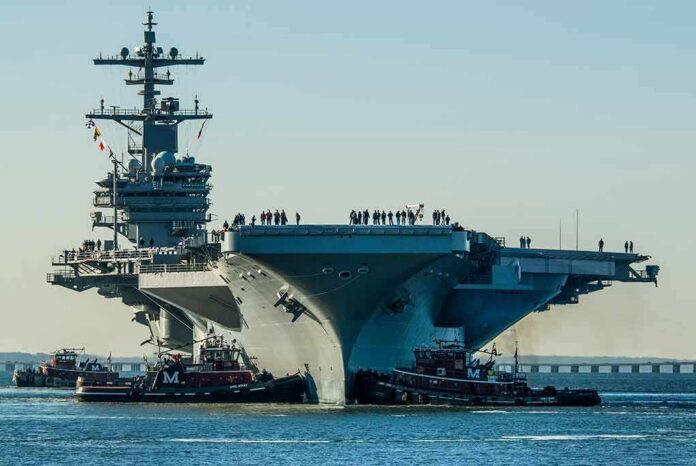
The Navy told USS George H.W. Bush families to brace for a worst-case 12-month deployment, and the holidays are off the table.
Story Snapshot
- Navy leaders told about 500 families on November 9 to plan for up to a year at sea.
- The carrier left Norfolk on March 31 for a six-to-seven-month plan that has been extended twice.
- The mission ties to ongoing Iran-related security needs in key waters.
- The extension message came through official channels, not rumor.
What Families Were Told And Why It Matters
Navy leaders held a town hall at Naval Station Norfolk on November 9 and told families the USS George H.W. Bush would not return for the holidays. They urged planning for a possible 12-month deployment. That guidance came after the carrier left Norfolk on March 31 for a standard six-to-seven-month cruise. Reports say this marks at least the second extension. The commanding officer, Capt. Justin Issler, also informed sailors of the change through the chain of command.
Officials tied the continued deployment to mission needs linked to Iran and maritime security. Media accounts describe an Iran-related mission and blockade tasks that require sustained carrier presence. One outlet based its story on audio from the family meeting that outlined the rationale. The Navy framed the yearlong timeline as a worst-case scenario, not a set return date. That distinction explains the guidance to plan for a long haul while leaders keep options open.
How This Fits The Larger Carrier Picture
Carrier deployments have been stretching across the fleet. Combatant commanders ask for visible, ready airpower at sea, and the Navy has fewer spare decks to rotate. Recent carriers spent about nine months deployed to meet demand. The pattern grew after crises in the Middle East pushed back expected return dates for multiple strike groups. The strain tracks with earlier cycles that trade surge ability against longer presence at sea.
Past examples show how long these missions can run. The carrier Gerald R. Ford and the carrier Dwight D. Eisenhower both stayed out beyond eight months when conditions heated up. Other deployments since 2024 crossed the 250-day mark. These cases show that a seven-month plan can slip when events drive risk higher. The Bush extension sits squarely in that trend and signals that demand again beats supply in the short term.
What Was Said In The Room, And What It Signals
Accounts of the Norfolk town hall show direct, plain talk with families. Leaders said the ship would miss the holidays and urged planning for a full year if needed. A report described pointed questions from spouses about mental health, child care, and money. The meeting tone underscored pressure on families when dates shift late in a deployment. That tension does not prove the mission is flawed, but it shows the human cost when the Navy stretches the rope.
Based on the USNI Fleet Tracker as of November 9, the deployment status of relevant U.S. Navy assets is as follows.
[Key Points]
(1) The USS Roosevelt Carrier Strike Group (CSG) called at Singapore on Saturday, the 7th, and departed on Monday, the 9th. It appears to be currently… https://t.co/LNWjQlMmlg— Hiro MORIKAWA | 森川洋也 (@HiroyaMORIKAWA) November 9, 2026
Some outlets also noted the broader Iran context and public messages that can look at odds with a longer carrier stay. When national leaders talk about deals or de-escalation while a ship extends, the picture can seem mixed. That is not unusual in policy. Military planners buy down risk with presence even as diplomats seek off-ramps. Families live with the hedge. Clear updates, target conditions, and realistic timelines are the best antidote to doubt.
The Conservative Read: Mission Clarity, Cost Honesty, And Family First
Strong defense starts with truth in plain English. The Navy did the right thing by telling families early to plan for a long cruise. That respects them. Now the job is to define the end state the carrier supports and the conditions to come home. If the mission is to keep sea lanes open and deter Iran-linked attacks, say it. If alternatives cannot meet the standard, explain why. That is common sense stewardship of people and power.
Retention and readiness depend on families as much as fuel and parts. The Navy should surge family services, mental health care, and childcare relief while the Bush remains out. Congress should make sure the money follows fast. Hard power without homefront support is a short fuse. The fleet can win the mission and keep faith by pairing hard schedules with honest plans, steady help, and a clear finish line the crew can see forming on the horizon.
Sources:
navytimes.com, militarytimes.com, jfeed.com, timesnownews.com