

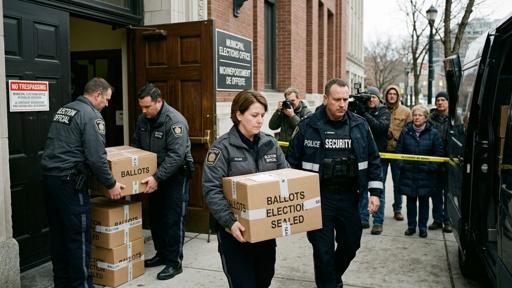
Burned vote-by-mail ballots discovered in a Los Angeles official drop box days before a mayoral election have renewed urgent questions about California’s ballot custody and transparency.
Story Snapshot
- Fire-damaged ballots were reportedly found inside an official Los Angeles drop box days before voting [7].
- California law criminalizes election interference and restricts access to voting technology and ballots [2][3].
- State officials tout paper ballots and audits, but do not resolve what happened in this incident [4][1].
- Public evidence so far does not identify who caused the damage or how ballots were handled afterward [7][9].
Documented Anomaly: Burned Ballots Inside An Official Drop Box
Local reporting described multiple vote-by-mail ballots with fire-related damage discovered inside an official Los Angeles ballot drop box in the days leading up to a mayoral election [7]. The timing, location, and condition of the ballots established a clear irregularity that goes beyond rumor. While the number of damaged ballots was not tied to any formal breach finding in the sources provided, the presence of fire-damaged ballots within a secured receptacle raises immediate chain-of-custody and voter-intent concerns [7].
Available research does not document a perpetrator, motive, or mechanism for how the damage occurred, leaving core investigative questions unanswered [7]. The record also lacks a registrar incident report, surveillance footage, or an official determination that the ballots were compromised or recoverable [7]. Without these details, voters are left with a verifiable irregularity but no public explanation, a gap that inevitably fuels doubts about whether basic safeguards actually functioned in this case [7][9].
California’s Stated Safeguards: Law, Paper Trails, And Audits
California officials emphasize that interfering with the election process is illegal and that ballot handling is tightly controlled, underscoring the seriousness of any custody lapse [3]. State materials also highlight layers of defense: paper ballots or voter-verifiable paper audit trails and manual audits of random samples after each election, which are meant to detect or limit damage from localized incidents [4]. Security briefings concede that threats are real even as they assert no evidence of systemic breaches in prior cases [1].
These assurances matter, but they do not, by themselves, answer what happened at the Los Angeles drop box. Paper backups and audits help validate totals, yet they do not automatically restore an individual voter’s intent when a ballot is charred or unreadable. State guidance details protections and signature verification, but the provided record does not say whether these specific burned ballots were duplicated, rejected, or successfully counted under established procedures [3][4]. That uncertainty leaves a real-world stress test without a public after-action report.
New Legal Tightening And The Transparency Deficit
Recent legislative action in California further restricts who may access ballots and voting technology, including a ban on police seizing ballots from county election officials without a court order [2]. The law’s thrust affirms that ballot custody is sensitive and must remain under defined authority to prevent politicized interference [2]. That same principle, however, argues for prompt, factual disclosures when custody anomalies occur so voters understand whether integrity was maintained or compromised in practice.
Officials and allied commentators frequently urge the public to ignore “false claims” and trust the system, but confidence depends on verifiable explanations, not slogans [9]. When a conspicuous event like burned ballots surfaces, the fastest route to trust is evidence: retrieval logs, chain-of-custody entries, incident reports, and, where feasible, forensic assessments. Absent that documentation, the state’s generalized reassurances can sound like a substitute for facts rather than a summary of them [3][4][9].
What Voters Deserve Now: Records, Forensics, And Accountability
Los Angeles County can strengthen public confidence by releasing the specific drop box’s retrieval timestamps, inspection notes, and any incident reports describing the damaged ballots’ discovery and handling. If available, surveillance video should be reviewed to determine whether the fire damage occurred before, during, or after deposit. A straightforward, evidence-based accounting—supported by the Secretary of State’s office where appropriate—would test whether the system’s touted safeguards worked as advertised [3][4][7].
California Election Security Under Fire After Ballots Found Burned https://t.co/HAjQ3A0Uds
— The Countess In Cowboy Boots (@LooneyOldLady) June 1, 2026
California leaders already admit that threats are real and that paper-backed audits are essential, a view consistent with common-sense election security [1][4]. The burned-ballots incident is precisely the sort of localized shock that these safeguards are supposed to withstand. To uphold voter trust—especially among those long skeptical of loose mail-in practices—officials should show their work: prove how many ballots were affected, how voter intent was preserved or not, and whether any custody weaknesses were fixed before the next vote [3][4][7][9].
Sources:
[1] Web – HERE WE GO: Burned Mail-In Ballots Found in Los Angeles Drop Box DAYS …
[2] Web – Hacking California’s Election System Would Be Difficult, Not …
[3] Web – California bans cops from seizing election ballots – CalMatters
[4] Web – California Trusted Information – California Secretary of State – …
[7] Web – Election Security | California Voter Foundation
[9] Web – California Legal Protections from Election Subversion and Voter …