

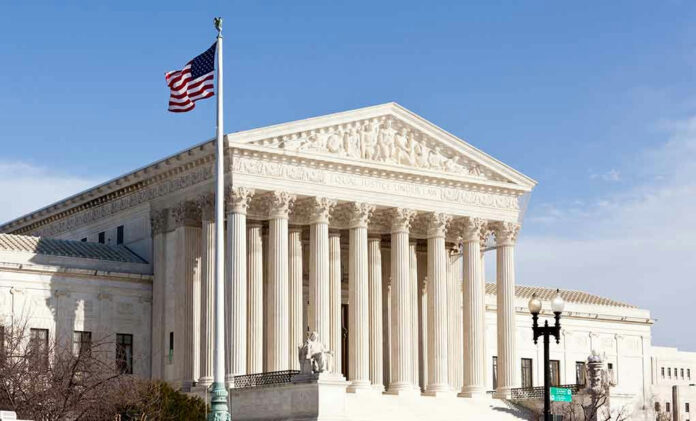
The Supreme Court’s 6-3 ruling shields girls’ sports from biological male competition and vindicates sex-based fairness under Title IX.
Story Highlights
- The Court upheld West Virginia and Idaho laws that define girls’ teams by biological sex.
- The majority tied Title IX’s plain meaning to biological sex, not gender identity.
- Twenty-seven states now restrict transgender participation in girls’ sports.
- Liberal justices dissented in part, previewing future legal fights.
Supreme Court Affirms States’ Power To Protect Fair Play
The Supreme Court ruled 6-3 that West Virginia’s and Idaho’s laws keeping biological males out of girls’ sports are constitutional, anchoring the decision to Title IX’s original meaning and equal protection principles. The majority treated sex-based teams as lawful lines that keep competition fair, echoing arguments that size, strength, and lung capacity confer real advantages in female categories. The ruling resolves those two cases and allows similar state laws to stand when challenged in federal courts.
State solicitors and representatives argued that sports depend on sex separation to secure safety and equal opportunity for women and girls. They told the justices that biological differences matter in speed, power, and endurance, and that schools are allowed to draw sex lines to protect fair play. Supporters included athletes, coaches, and parents who said girls lose roster spots and medals when males compete in female divisions, and urged the Court to respect the plain text of Title IX.
Title IX’s Text And The Court’s Original Reading
The Court’s opinion read Title IX, passed in 1972, as referring to biological sex. That approach tracks decades of practice where schools field separate boys’ and girls’ teams to expand chances for female athletes. The majority did not adopt gender identity as a controlling category. Instead, it said states may preserve sex-based teams to advance fairness and safety in competition, consistent with the Constitution and federal law. That reading limits agency reinterpretations that try to rewrite the statute’s words after the fact.
The ruling follows years of swift state action. By early 2026, twenty-seven states had laws or policies barring transgender participation in girls’ sports based on gender identity, most at the K-12 and college levels. The Court’s decision reduces legal uncertainty in those states. It tells lower courts to respect legislative judgments that rest on clear biological lines. It also signals that sex separation in school athletics remains lawful when tied to competitive fairness and equal opportunity for women.
What The Decision Does And What It Does Not Do
The decision resolves the West Virginia and Idaho cases and endorses laws that sort athletes by biological sex. It does not craft a nationwide statute or rewrite Title IX’s text. Instead, it gives strong legal cover to states that passed similar protections. Civil rights groups plan more lawsuits, and the dissent by Justice Sonia Sotomayor, joined by Justices Elena Kagan and Ketanji Brown Jackson, previews lines of attack they may press in future cases.
Opponents argue that bans are discriminatory and should allow case-by-case exceptions, such as for athletes on hormone suppression. They cite the Supreme Court’s 2020 employment ruling in Bostock to claim sex discrimination laws should reach gender identity in schools. The majority did not adopt that view here. It centered the text and history of Title IX in education and the long-standing legality of sex-separated teams.
Implications For Schools, Parents, And Female Athletes
School districts in states with sex-based sports laws now have clearer ground to enforce them. Athletic directors can set team rosters by biological sex and defend cuts, championships, and scholarships that hinge on fair competition. Parents who worried their daughters would lose spots to biological males gain legal backing for local policies. More states may now move bills off the shelf, pointing to the Court’s logic and the growth of state protections since 2020.
Breaking: Supreme Court Delivers Win for Women's Sports in Landmark Transgender Athletes Ruling via @WestJournalism https://t.co/naGsVAVvPj
— Jeffrey Conz (@JeffreyConz1) June 30, 2026
The fight is not over in states without laws. Lawsuits will continue, and media outlets will frame the ruling as divisive. But the Court has drawn a firm line: Title IX protects women’s sports as a sex-based category. That narrows room for bureaucratic overreach and ideological experiments in school athletics. For families, coaches, and girls on the field, this is a practical win. It restores common sense, respects biology, and keeps opportunity where Title IX intended it to be.
Sources:
[1] Web – BREAKING: Supreme Court Upholds Schools’ Right to Ban Biological Boys …
[2] Web – Supreme Court arguments on transgender athletes in sports – CNN
[4] YouTube – Supreme Court seems likely to allow state bans of transgender …
[5] Web – Unpacking the transgender athletes’ case at the Supreme Court
[10] Web – Ban on Transgender Women From Female Sports Is Challenged in …
[13] YouTube – Supreme Court weighs challenges to state bans on transgender …
[15] Web – US Supreme Court conservatives lean toward allowing transgender …