

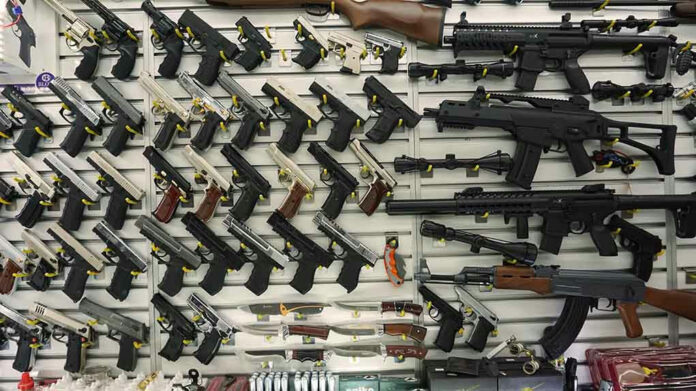
When a federal agency can quietly decide which common firearms “count” as sport and which do not, both gun owners and civil libertarians see a rule that looks less like safety and more like creeping, backdoor control.
Story Snapshot
- The “sporting purposes” test comes directly from the Gun Control Act’s import rules but leaves wide room for agency interpretation.
- The Bureau of Alcohol, Tobacco, Firearms and Explosives (ATF) has used it for decades to block imports of certain rifles, shotguns, handguns, and even some ammunition.
- Critics across the spectrum argue the standard is vague, outdated, opaque, and easily weaponized by unaccountable bureaucrats.
- New court decisions and legislation aim to rein in ATF discretion, raising the question of whether this test is now a “dead infringement walking.”
Where the “Sporting Purposes” Test Came From
Congress wrote the “sporting purposes” language into the 1968 Gun Control Act to govern what firearms may be imported into the United States.[6] The statute allows importation only if a firearm is “generally recognized as particularly suitable for or readily adaptable to sporting purposes,” giving federal regulators a gatekeeping role at the border.[6] The Department of Justice archive explains that this requirement was used to block imports of firearms deemed not suitable for traditional sporting use and remains embedded in federal law today.[6]
The Bureau of Alcohol, Tobacco, Firearms and Explosives built detailed frameworks on top of that vague phrase, developing factor tests for handguns and studies for shotguns and rifles that translate “sporting purposes” into points, features, and technical thresholds.[4] For example, the handgun factoring system assigns scores for size, weight, caliber, and safety features, and handguns with seventy-five points or more are treated as “sporting” and eligible for import.[4][6] Shotgun import studies similarly evaluate magazine capacity, configuration, and intended use.[2]
How ATF Uses the Test to Control Firearms and Ammunition
The Department of the Treasury, which oversaw firearms regulation before authority shifted fully to the Department of Justice, used the sporting standard in 1998 to prohibit importation of modified semiautomatic assault-style rifles that could accept large-capacity military magazines, concluding they were not for sporting purposes.[7] The Department of Justice archive confirms that military-style semiautomatic rifles were deemed nonimportable under this framework, keeping entire categories of civilian-usable firearms out of the market based on regulators’ judgment of sport.[6][7]
The same logic extends beyond firearms to certain armor-piercing ammunition, where ATF created a “sporting purposes” exemption process that determines whether projectiles are “primarily intended” for sporting use.[2][1] ATF guidance lays out steps for evaluating caliber, construction, and common use, but it also states that the agency “retains the discretion to deny any request,” underscoring that these determinations are not purely mechanical.[2] In practice, this discretion lets the agency choose which calibers and configurations stay available for lawful sporting use and which are effectively banned from the civilian market.[2]
Vague Standards, Old Criteria, and Growing Distrust
Gun rights advocates, industry lawyers, and some civil libertarians argue that the phrase “sporting purposes” is so broad and undefined that it grants ATF almost open-ended power.[1][9] Analytical work on the test notes that the Gun Control Act provides “little explicit guidance” on what counts as a sporting purpose, leaving the agency to decide which activities qualify and which designs are acceptable.[1] That discretion allows ATF to revisit and revise its interpretation as politics change, feeding the perception of a moving target controlled by unelected officials.[1][9]
ATF’s own history adds to that concern. The Department of Justice archive explains that handgun import criteria—such as length, weight, and construction—trace back to 1968 and have not been reexamined since.[6] Critics argue that using decades-old assumptions ignores today’s reality, where many Americans view self-defense training, practical competitions, and modern sporting rifles as normal parts of lawful gun culture.[2] When an old definition of “sport” is used to block contemporary designs, both conservatives and many independents see outdated rules privileging bureaucratic judgment over citizen choice.[2]
Selective Burdens and Quiet Interpretive Shifts
Another major complaint is that the sporting test hits imports hard while leaving domestic production relatively freer. The Department of Justice archive notes that imported firearms must satisfy sporting-purpose criteria, but domestically produced handguns are not held to the same factoring standards.[6] That asymmetry lets the government distort the market by disfavoring foreign-made options, which fuels suspicion that the test is less about safety and more about maintaining leverage over a subset of gun owners and businesses.[6]
Recent interpretive changes have intensified these worries. A legal analysis describes how ATF has reinterpreted what counts as a handgun, using private classification letters to declare that firearms which are “too long” or “too heavy” no longer meet the statutory definition of handgun and thus cannot qualify for import under the handgun sporting criteria.[4] ATF lists “objective design features” like rifle sights, rifle-caliber ammunition, barrel length, and weight, but then explicitly says those factors are “neither binding on future classifications nor is any factor individually determinative,” signaling that examiners’ case-by-case discretion ultimately rules.[4]
Legislative Pushback and a Post-Bruen Legal Climate
Members of Congress have begun targeting this discretion directly. The Sporting Firearms Access Act, introduced by Senators Bill Cassidy and Jim Risch, would “clarify the definition of ‘sporting purposes’” and stop ATF from “arbitrarily” denying import requests for firearms and ammunition.[5] The bill would require recognition of firearms used for hunting, target shooting, and competitions, bar denials of items substantially similar to those already in circulation, and create an appeals process plus judicial review for contested decisions.[5][3]
These moves unfold in a legal environment where courts have shown less patience for executive agencies stretching statutory language, as seen in litigation over bump stock rules and broader Second Amendment cases after recent Supreme Court decisions.[3][9] While no modern court ruling in this record has struck down the sporting-purposes test outright, the combination of vague statutory language, opaque internal processes, and highly political subject matter leaves the framework vulnerable.[1][4] For many Americans across the spectrum who already distrust “deep state” agencies, the test looks increasingly like a “dead infringement walking” awaiting its next challenge.[1][5]
Sources:
[1] Web – [PDF] Bureau of Alcohol, Tobacco, Firearms, and Explosives Topic: Ban …
[2] Web – [PDF] -1- To protect the lives and safety of law enforcement officers …
[3] Web – NSSF Welcomes U.S. Sen. Jim Risch’s Sporting Firearms Access …
[4] Web – ATF Interpretive Change Restricts Handgun Imports and May …
[5] Web – Federal Assault Weapons Ban – Wikipedia
[6] Web – USDOJ: United States Department of Justice Archive – Appendix C
[7] Web – TREASURY PROHIBITS IMPORTATION OF CERTAIN …
[9] Web – [PDF] the “sporting purposes” test for imported firearms – Geek Gunman