

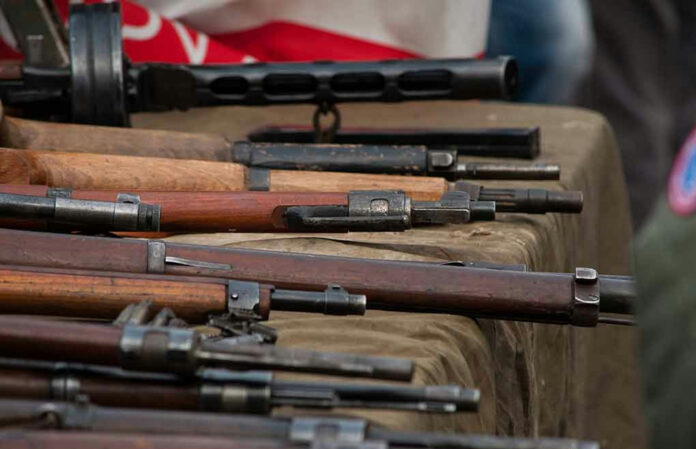
Revolutionary War-era muskets and their replicas slip through modern gun regulations, revealing a legal loophole that allows Americans to buy, own, and carry these firearms without background checks or federal oversight.
Federal Law Creates Sweeping Exemption for Colonial-Era Weapons
The Gun Control Act of 1968 established a clear exemption for antique firearms manufactured before 1899 or replicas using black powder ignition systems. Muskets resembling those carried at Bunker Hill and Yorktown fall squarely within this definition under 18 U.S.C. § 921(a)(16). These smoothbore flintlocks require no Federal Firearms License for purchase, no serial numbers, and no background checks. The Bureau of Alcohol, Tobacco, Firearms and Explosives reaffirmed this stance in January 2025, declaring black powder muzzleloaders exempt from National Firearms Act restrictions. Approximately 95 percent of these weapons remain federally unregulated, creating what amounts to an unrestricted firearms category.
Historical Mandate Meets Modern Rights Debate
Colonial America not only permitted musket ownership but mandated it for militia-eligible males. Massachusetts required “full musket bore” arms in 1645, while New Hampshire law in 1716 compelled men aged 16 to 60 to bear arms. The Brown Bess and Charleville muskets that won independence were .75-caliber flintlocks firing loose black powder charges. When the Founders ratified the Second Amendment in 1791, these were the arms they knew. The 2022 Supreme Court decision in NYSRPA v. Bruen emphasized historical tradition in gun rights, inadvertently spotlighting these unregulated antiques as the constitutional baseline. This underscores a fundamental tension: regulations designed for modern semi-automatic weapons simply do not apply to the very firearms that secured American liberty.
State Governments Scramble to Close Perceived Gap
California, New York, New Jersey, and four other states enacted legislation in 2025 requiring serial numbers on post-1899 replica firearms, attempting to bring these weapons under existing tracking systems. California’s AB 1594 specifically targets reproductions manufactured after 1899, though enforcement remains murky for firearms lacking modern components. The Firearms Policy Coalition filed suit against Hawaii in January 2026 over musket restrictions, arguing the state violated rights protected under Bruen. Gun Owners of America claims these state efforts amount to unconstitutional infringement on historical arms that predate all modern regulations. The Supreme Court’s April 2026 denial of certiorari in United States v. Antique Arms effectively upheld the federal exemption, leaving states to navigate their own regulatory frameworks without clear guidance.
Booming Market Reflects Deeper Frustration With Gun Policies
Replica musket sales jumped 30 percent in 2025, fueling a $200 million industry built on firearms ranging from $500 starter models to $2,000 museum-quality reproductions. Manufacturers like Traditions Firearms report unprecedented demand from collectors, reenactors, and gun owners seeking alternatives to heavily regulated modern firearms. FBI data shows antique firearms account for just 0.2 percent of gun crimes in 2025, suggesting these weapons pose minimal public safety risk. Yet Everytown for Gun Safety and similar organizations label the exemption a “Trojan horse for deregulation,” warning that normalizing unregulated carry could undermine assault weapon bans. The divide illustrates a broader American frustration: neither side trusts federal institutions to balance constitutional rights with reasonable safety measures, leaving citizens to exploit legal gray areas or fight rearguard actions in state legislatures.
Muskets like those from 1776 are mostly exempt from today’s gun laws https://t.co/hacsUM2JVv pic.twitter.com/ii771wL5SX
— The Independent (@Independent) May 14, 2026
Constitutional Scholars Split on Revolutionary Weapons
Professor Nelson Lund of Antonin Scalia Law School argues the Second Amendment protects arms in common use, with muskets representing the historical standard the Founders intended to preserve. Duke University’s Professor Jacob Charles counters that the 1968 exemption is an outdated relic, claiming modern replicas exploit legislative intent designed for genuine antiques. ATF historians maintain the distinction is purely definitional, applying statutory language without policy advocacy. The dispute reflects fundamental disagreement over originalist interpretation versus evolving standards. For gun rights advocates who weathered years of what they view as unconstitutional erosion of Second Amendment protections, these exemptions represent a rare acknowledgment of historical reality. For those seeking tighter controls, they represent dangerous loopholes that prioritize legal technicalities over public safety in an era where government dysfunction prevents sensible compromise.
Sources:
American Revolution Institute: A Revolution in Arms Exhibition
Colonial Firearm Regulation – Pat Costa