

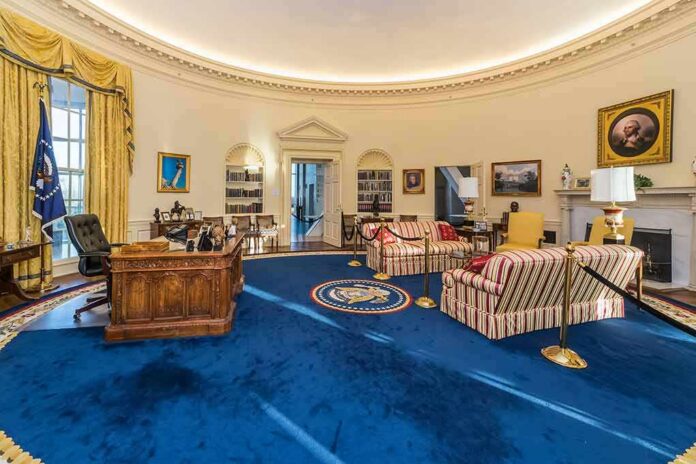
President Trump has opened a direct line from the Oval Office to America’s military families, putting spouses’ everyday struggles at the center of national defense.
Story Snapshot
- President Trump signed an executive order creating the President’s Military Spouse Commission to advise him directly on military family policy.
- The commission will focus on real-life spouse challenges like housing, childcare, health care, employment, and education as part of military readiness.
- This new body builds on Trump’s earlier efforts that pushed federal agencies to hire more military spouses for good-paying government jobs.
- The commission could help roll back leftover Biden-era bureaucracy and make sure help for military families is real, not just talk.
Trump Puts Military Families at the Center of Readiness
President Trump’s new executive order creates the President’s Military Spouse Commission, a White House body designed to put military families “at the heart of military readiness,” according to officials who described the move. The commission’s job is to advise the president on policies that affect military spouses and families and to give him annual recommendations to improve their quality of life. This ties home-front issues directly to national security, instead of treating spouse problems as side topics.
The commission is structured to give the White House a direct line to the daily challenges military spouses face, including childcare, employment, housing, health care, education, and repeated deployments. Trump is expected to sign the order alongside Defense Secretary Pete Hegseth, his wife Jennifer, Chairman of the Joint Chiefs of Staff General Dan Caine, and several military spouses, underscoring that this is not just a paperwork move but a visible commitment to families who carry the burden of service. The message is clear: supporting the family is part of supporting the warrior.
Who Will Serve on the President’s Military Spouse Commission
The commission will be chaired by Jennifer Hegseth, the wife of Defense Secretary Pete Hegseth, giving a military spouse with direct insight into Pentagon life a leading role. President Trump will appoint an executive director, and Homeland Security Secretary Markwayne Mullin’s wife, Christie Mullin, will serve as a member along with about 20 other military spouses. These spouses will represent the service secretaries, the Joint Chiefs of Staff, and each branch’s senior enlisted leader, creating a council that reaches across the armed forces. That structure is meant to pull in real stories from base housing to deployment cycles.
Some critics may say this lineup looks like insiders talking to insiders, but the commission’s design also reflects a simple reality: spouses of senior leaders hear problems straight from the ranks and can carry those concerns directly into policy talks. For conservative readers, that means there is finally a formal seat at the table for the people who deal with broken childcare systems, poor housing, and unstable jobs every time the military orders another move. If this commission pushes agencies to fix those issues, it strengthens readiness without growing government for its own sake.
Building on Trump’s Earlier Action for Military Spouses
This commission does not come out of nowhere. Back in 2018, President Trump signed Executive Order 13832, “Enhancing Noncompetitive Civil Service Appointments of Military Spouses,” which told federal agencies to use an existing hiring authority to bring more military spouses into federal jobs. The order required agencies to promote that hiring authority, directed the Office of Personnel Management to teach agencies how to use it, and demanded yearly reports on how many spouses were hired. It also pushed agencies to suggest ways to improve license portability and remove barriers to spouse employment.
That earlier order kept faith with both military families and veterans by clearly stating that it did not force agencies to hire a spouse over other applicants and did not take jobs or preference away from veterans. Later reporting showed that the order helped spouses tap into federal jobs nationwide through the special hiring authority, opening a path to stable work even as families moved from base to base. By creating the new commission now, Trump is adding a policy “brain” focused on spouses to sit on top of those concrete hiring tools, aiming to connect problems in housing, childcare, and health care with solutions that agencies can actually carry out.
Turning Away from Symbolism and Back Toward Substance
Under President Biden, Executive Order 14100 was billed as “the most comprehensive set of administrative actions in our nation’s history” to support the economic security of military families, veterans’ spouses, caregivers, and survivors. The order talked about broad goals like more flexibility, more support, and more resources, and promoted ideas such as leave for Permanent Change of Station moves and more remote work options. But like many Biden-era moves, it came with legal language that stressed it created no enforceable rights or benefits and depended on available appropriations. In practice, that meant a lot of promises without guaranteed delivery.
🇺🇸 @POTUS Signs EO Creating the Military Spouse Commission
President Trump has signed a new executive order establishing the President's Military Spouse Commission, a White House initiative focused on supporting the families who stand behind America's servicemembers.
The… pic.twitter.com/esTJO1jzEr
— LindellTV (@RealLindellTV) August 3, 2026
Trump’s commission takes a different path by focusing on direct advice and yearly recommendations tied to real-world measures of military readiness. Instead of sweeping language that expands bureaucracy, this effort is meant to sharpen the use of existing tools—like the military spouse hiring authority already recognized by the Office of Personnel Management—by putting spouse voices into the policy loop. For conservatives who are tired of “woke” priorities and press releases that ignore the basics of family life, a commission built around housing, childcare, health care, education, and steady work looks like a step back toward common sense and a stronger, focused military.
Sources:
facebook.com, kotaradio.com, trumpwhitehouse.archives.gov, govinfo.gov, pbs.org, digital-client-solutions.hlc.com, jmc.army.mil, presidency.ucsb.edu