
America’s top diplomat is warning that a U.S.-China war would be “catastrophic for the world” even as Washington deepens a tense, high-stakes relationship with Beijing.
Story Snapshot
- Secretary of State Marco Rubio says the United States and China “have to have a relationship” and that cutting off talks would be “reckless and irresponsible.”
- Rubio describes diplomacy with China as a “delicate balancing act” between defending U.S. interests and avoiding a conflict he calls catastrophic.
- The comments came at a meeting of Southeast Asian foreign ministers, as the United States prepares for President Xi Jinping’s visit to Washington and tries to cool growing tensions.
- Rubio argues both countries must manage long-term disputes over trade, security, and Taiwan while keeping open lines of communication to prevent crisis.
Rubio warns of catastrophic stakes while pushing dialogue
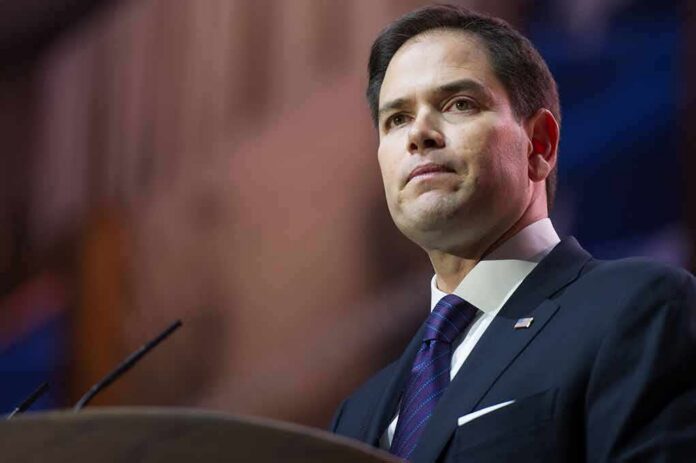
Secretary of State Marco Rubio used his appearance at the Association of Southeast Asian Nations meeting in Manila to deliver a stark message about the risk of a United States-China clash. He said any economic or military conflict between the world’s two largest economies would be “really catastrophic for the world” and stressed that leaders on both sides have an “obligation” to prevent that outcome. Rubio tied that warning directly to the need for constant communication, saying it is important “to continue to talk to China irrespective of our differences.”
Rubio’s remarks did not come at a quiet moment in the relationship. He met Chinese Foreign Minister Wang Yi on the sidelines of the Manila gathering to discuss how to handle “great differences” over issues like trade, security, and China’s backing of Russia. Both governments are preparing for President Xi Jinping’s expected visit to the United States, and Rubio said their goal is to manage disagreements so Xi has a “very positive visit” while the two sides work on “strategic stability” and crisis prevention.
“We have to have a relationship” with a major rival
Rubio has been repeating a blunt core idea: the United States and China “have to have a relationship” whether they like it or not. In his Manila press remarks, he called the two countries “the two most powerful countries in the world, particularly economics,” and said it would “frankly be reckless and irresponsible” not to maintain dialogue and a working relationship. He pointed back to the Cold War, noting that even at its tensest moments the United States and the Soviet Union kept military and diplomatic channels open, which he said helped prevent disaster.
In an earlier interview, Rubio explained why he believes talking to China is not optional for Washington. He described the United States and China as the world’s two largest economies and “probably the two most powerful militaries,” and said it would be “irresponsible” not to have direct dialogue. He argued that there is “probably virtually no problem in the world that we can’t solve if we work together on it,” while also warning there will always be “irritants” and areas where the countries are competitors or even direct adversaries. For many Americans who see China as a threat, this dual message — talk, but stand firm — can sound like a tightrope walk.
A delicate balancing act between competition and peace
Rubio’s “delicate balancing act” comment captures a wider pattern in United States policy toward China: push back hard where interests clash, but keep talking to avoid a blowup. He has called for “strategic stability” in the relationship, meaning both sides try to reduce misunderstandings that could turn small incidents into larger crises, especially around flashpoints like Taiwan. Rubio has also said that any forced change in the status quo across the Taiwan Strait would be “bad for both countries,” and that United States policy on Taiwan “is unchanged,” signaling limits to how far Washington will bend.
Secretary of State Marco Rubio says maintaining a working relationship with China requires a "delicate balancing act."
He warns that any military or economic conflict between the U.S. and China would be "catastrophic" for both countries and the world.
Rubio adds the U.S. must… pic.twitter.com/rTZQNUyZQm
— Fox News (@FoxNews) August 2, 2026
For Americans on both the right and the left, this approach can feed deep frustrations about how the federal government handles powerful rivals. Many conservatives see decades of globalist trade with China as having hollowed out factory towns and helped a country they view as a communist adversary. Many liberals worry that big corporations and elites profit from cheap labor and overseas markets while workers and communities at home fall behind. Rubio’s insistence that the United States must keep engaging China, even as he talks about threats and adversaries, speaks directly into those fears of a system that feels rigged and a ruling class that seems comfortable doing business with a rival power.
Why this matters for ordinary Americans
Rubio’s warning about a “catastrophic” United States-China conflict is not abstract for families who have lived through inflation, supply chain shocks, and rising energy costs. A breakdown with China could mean higher prices, job losses, and new military risks, all hitting regular people long before it hurts the well-connected elites in Washington and on Wall Street. At the same time, many citizens worry that constant talk of “strategic stability” can become an excuse for never really confronting unfair trade, intellectual property theft, or human rights abuses that cut against America’s founding ideals.
The secretary of state is betting that Americans will accept a hard-nosed mix: talk to China to avoid war, but defend national interests and values more sharply inside that relationship. Whether that promise feels credible to voters who already doubt the federal government’s honesty and priorities is an open question. For now, Rubio’s message is clear: the United States cannot walk away from China, and doing so would be dangerous — but if that delicate balancing act fails, it will be ordinary Americans, not the deep-state elites, who pay the highest price.
Sources:
facebook.com, state.gov, china.usembassy-china.org.cn, washingtonpost.com, nytimes.com, aljazeera.com, en.wikipedia.org, apnews.com, youtube.com