

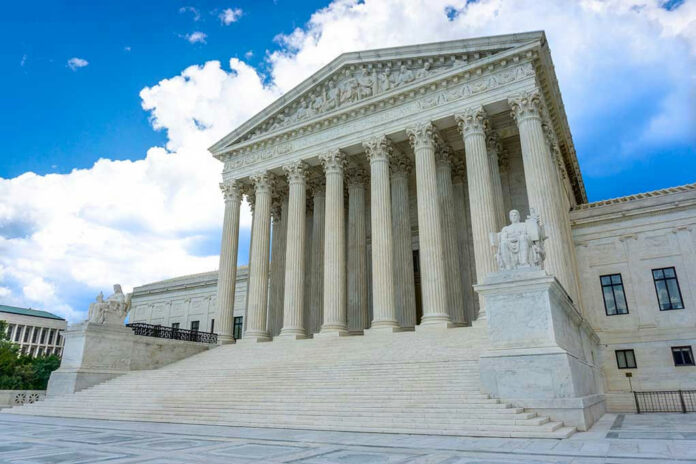
The Supreme Court just sidestepped a key question on IQ and the death penalty, leaving life‑and‑death standards in the hands of the same blue-state courts and academics who already tried to gut capital punishment once before.
Story Snapshot
- The Supreme Court declined to reset a clear national IQ standard for death penalty cases, keeping a murky, case‑by‑case approach in place.
- Earlier rulings like Hall v. Florida barred rigid IQ cutoffs, forcing states to weigh “holistic” evidence and expert testimony.
- Critics warn this flexible standard invites activist judges and liberal experts to chip away at capital punishment from the inside.[4]
- Conservatives now face a patchwork of rules where life‑and‑death decisions can hinge on which judge, jury, or psychologist you draw.[2][4]
How We Got Here: From Atkins to Hall and Today’s “Non‑Decision”
Two decades of Supreme Court rulings have slowly turned IQ in capital cases from a straightforward number into a legal maze. In Atkins v. Virginia, the Court barred executing people with intellectual disability but let states define how to apply that rule. Florida then adopted a bright‑line cutoff at an IQ of 70, blocking defendants above that score from even presenting further evidence of disability. In Hall v. Florida, the Court struck down that rigid rule, saying IQ scores are imprecise and must be treated as ranges, not exact numbers.
Hall held that when a defendant’s IQ falls within roughly 70 to 75, he must be allowed to present additional clinical evidence of intellectual disability, especially problems with everyday functioning that began before age 18. Justice Anthony Kennedy’s majority opinion warned that Florida’s cutoff “creates an unacceptable risk” that a person with intellectual disability will be executed and is therefore unconstitutional. That decision forced states to abandon simple numerical thresholds and drove courts toward a “holistic” model that leans heavily on expert testimony and adaptive‑functioning claims.[2]
Hamm v. Smith and the Fight Over Multiple IQ Scores
That flexible framework came under fresh scrutiny in Hamm v. Smith, a case involving an Alabama inmate who recorded IQ scores between 72 and 78. A federal district court applied Hall, treated the scores as a range, and found his true IQ could be at or below 70, then weighed school records and adaptive deficits before concluding he met the intellectual disability standard.[1][4] The United States Court of Appeals for the Eleventh Circuit affirmed, emphasizing that courts must look at all scores and surrounding evidence, not just the highest number.[1][4]
Alabama pushed back, arguing states should be permitted to treat a consistent pattern of scores above 70 as dispositive, so long as defendants still have a chance to introduce adaptive‑function evidence.[3][4] A JURIST explainer notes that even the federal government supported keeping the burden of proof on the prisoner and resisted any rule that would force courts to treat the lowest end of every score’s range as controlling.[4] When the Supreme Court took Hamm, many observers expected a definitive answer on how to handle multiple scores and where a line, if any, should be drawn.[3][4]
What the Court Left Unsaid — and Why It Matters
Instead of delivering a bright‑line rule or clarifying exactly how Hall applies to multiple IQ scores, the Supreme Court ultimately sent mixed signals and declined to announce a new nationwide standard.[3][4] The Justices confirmed that rigid, one‑number cutoffs like Florida’s former rule remain unconstitutional, but they stopped short of saying how far states can go in treating higher scores as effectively fatal to a disability claim. That silence leaves lower courts and state legislatures with wide latitude to design their own tests, provided they do not openly copy the old Florida model.
Legal analysts warn this patchwork invites inconsistency and ideological gamesmanship.[2][4] In one state, a defendant with scores in the low 70s could be found ineligible for execution based on school records and testimony about daily‑living struggles.[1][2] In another, the same testing history might be brushed aside as judges emphasize the higher scores and declare the prisoner above the legal threshold.[4] With no fresh guidance from the Supreme Court, the risk is that capital punishment policy depends less on the crime and more on which court of appeals you happen to fall under.
Conservative Concerns: Justice, Not Judicial Activism
Many conservatives support the principle that truly intellectually disabled offenders should not be executed, but they also see how vague standards can be weaponized by activists to erode the death penalty altogether. Professional guilds and liberal advocacy groups have pushed hard for ever‑broader definitions of disability, insisting that diagnosis must involve “comprehensive clinical assessment” that “goes beyond just IQ scores.” While that language sounds neutral, it empowers experts whose views often track progressive politics rather than the plain meaning of the Constitution.
Once the Supreme Court rejected clear cutoffs in Hall and then declined to tighten the rules in Hamm, capital cases became fertile ground for endless litigation, dueling experts, and soft‑on‑crime judges stretching “adaptive functioning” to cover almost anyone they want to spare.[4] That dynamic undercuts the certainty juries expect when they impose the ultimate punishment on murderers and sends a message of instability to victims’ families. With the Court sidelining itself, the responsibility now falls squarely on conservative lawmakers and state courts to defend both due process and accountability without letting activist judges quietly dismantle the death penalty case by case.
Sources:
[1] Web – US Supreme Court strikes IQ cutoff for death penalty cases
[2] Web – Intellectual Disability, IQ Scores, and the Death Penalty
[3] Web – The Supreme Court To Decide on How IQ Tests Can Affect the …
[4] Web – Explainer: US Supreme Court to Review How IQ Scores May …