

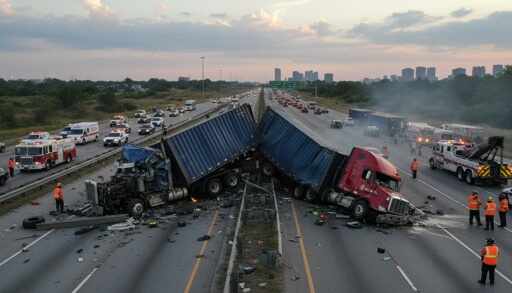
When a young undocumented truck driver killed three people in a fiery eight‑vehicle crash and got less than five years in prison, many Americans saw it as proof that the system protects itself better than it protects them.
Story Snapshot
- A 21-year-old undocumented semi-truck driver received 4 years and 8 months after a crash that killed three and injured four.
- The judge cited his age, clean record, and lack of intoxication or phone use as reasons for a sentence under half the 10-year maximum.
- Families and online commenters blasted the punishment as a “slap on the wrist” and “not justice,” fueling distrust of courts and regulators.
- The case exposes deeper failures in licensing, immigration enforcement, and highway safety that go far beyond one judge or one driver.
Deadly crash and a sentence that shocked the public
On a busy day on the 10 Freeway in Ontario, California, 21-year-old truck driver Jashanpreet Singh slammed his semi into stopped traffic, starting an eight-vehicle pileup that killed three people and injured four others. Prosecutors said his big rig hit at high speed, striking seven other vehicles, including three more semi-trucks and several passenger cars. The crash burned vehicles, trapped victims, and turned a normal commute into a scene of chaos that families will never forget.
Singh later pleaded guilty to three counts of vehicular manslaughter with gross negligence, plus one count of reckless driving causing injury. The San Bernardino County District Attorney’s Office said he was not charged with murder because investigators found no sign that he intended to cause the crash. Instead, they said his conduct showed gross negligence behind the wheel of a commercial truck, a serious felony but one treated differently than a deliberate killing under California law.
Judge’s reasoning: youth, clean record, and no intoxication
At sentencing in Rancho Cucamonga, Judge Shannon Faherty gave Singh four years and eight months in state prison, less than half of the 10-year maximum that some media outlets and critics highlighted. She said the law required her to weigh mitigating factors, including Singh’s age, his lack of criminal or violent history, and the fact that the crash was not believed to be intentional. Under California’s youth offender rules, judges can reduce sentences for offenders 23 or younger when other factors support leniency.
Earlier, police and prosecutors had brought a felony driving under the influence charge, but toxicology tests came back negative for drugs and alcohol. After that, the prosecution dropped the DUI count and focused on vehicular manslaughter with gross negligence and reckless driving. The judge also said there was no solid evidence that Singh was distracted by his phone or engaged in other aggravating behavior beyond failing to safely control his truck in heavy traffic. That pushed the case firmly into the “gross negligence, non-DUI” category that usually carries two, four, or six years, depending on the facts.
Families’ pain and a growing sense the system is rigged
Inside the courtroom, victim impact statements tried to give faces to the numbers. The family of construction worker Jaime Florez described him as a hard-working provider who left for his job and never came home. Statements showed a family that believed in effort and responsibility, only to see their loved one taken in seconds on a state highway they had no power to make safer. Two other victim families chose not to speak publicly, a silence that still weighs on the case.
Outside the courtroom, anger spread fast. Social media posts and videos called the sentence a “slap on the wrist” and “not justice,” and many focused on Singh’s status as an undocumented immigrant who entered the United States in 2022 yet held a valid California commercial driver’s license. To people already frustrated by illegal immigration, rising highway danger, and what they see as soft crime policies, the idea that an undocumented driver could kill three people and serve under five years felt like proof that the rules favor elites and institutions over ordinary citizens.
Behind one case: deeper failures in law, licensing, and trust
The sentence itself fits a wider pattern. Legal guides show that gross vehicular manslaughter without intoxication can be charged as a felony with typical terms of two, four, or six years, and many multi-victim cases still land around four years when there is no DUI and no prior record. That legal framework helps explain how the judge reached four years and eight months, but it does little to answer the deeper question that many Americans are asking: why do so many deadly failures on the road feel like they end with light consequences?
This is so messed up… it’s not right.
CA Judge Shannon L. Faherty sentenced illegal alien Truck driver Jashanpreet Singh only 4 years 8 months after killing 3 Americans
The sentencing structure in CA would have allowed for at least 18 years, so this ruling was entirely based… pic.twitter.com/Oe21JsnPPl
— MJTruthUltra (@MJTruthUltra) July 15, 2026
This case also exposes gaps that worry people on the left and the right. California’s Department of Motor Vehicles can investigate serious crashes and suspend or revoke licenses, but Singh held a valid commercial license even as an undocumented immigrant, raising doubts about how closely regulators guard public safety when business and labor pressure push for more drivers. Families must now depend on civil lawsuits and possible trucking-company investigations to learn whether training, maintenance, or hours on the road played a role, areas that often stay hidden from public view.
Sources:
pjmedia.com, nbclosangeles.com, latimes.com, youtube.com, abc7.com, hindustantimes.com, instagram.com, law.justia.com, pbs.org, da.sbcounty.gov