

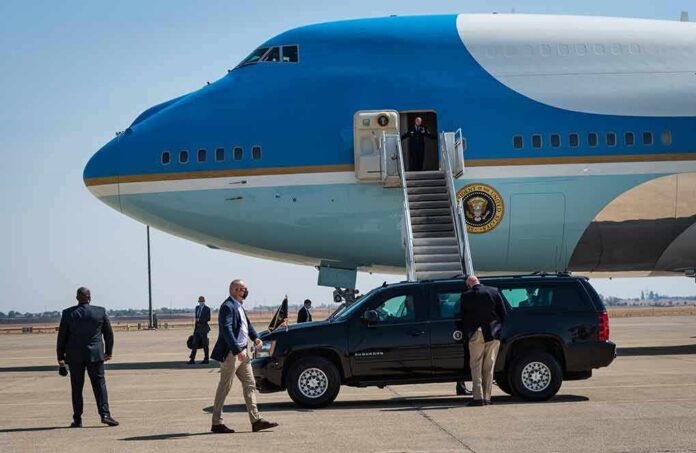
President Trump confirmed leader-level talks with Russia and China to press denuclearization and discuss the Ukraine war at the Shenzhen APEC summit.
Story Highlights
- Trump said he plans talks with Vladimir Putin and Xi Jinping that include denuclearization.
- U.S. officials confirmed a first-ever trilateral meeting on the APEC sidelines in China.
- Reports placed the gathering in Shenzhen on November 19 with a broad agenda.
- Officials did not expect a concrete nuclear agreement from this initial conversation.
Trump Sets Denuclearization Push With Putin and Xi
President Trump told reporters he expects to meet Russia’s Vladimir Putin and China’s Xi Jinping in China and “talk a lot of things, including denuclearization.” Reuters reported the remarks came November 8 before Trump’s return flight from Florida. ABC News later said senior U.S. officials confirmed the leaders would hold their first trilateral session on the margins of the Asia-Pacific summit, with denuclearization as a focus. Trump also flagged Ukraine and Iran as likely topics during the week’s talks.
Reporting placed the meeting in Shenzhen during the November 18–19 summit, with the sit-down planned for November 19. Bloomberg cited the White House in noting the timing and location. The United Nations signaled support for any credible effort that lowers nuclear risk and advances peace if the discussions move forward productively. Trump previously said Washington was talking with both Moscow and Beijing about denuclearization, setting the stage for direct leader engagement.
Scope, Expectations, and Limits Set by Officials
Senior officials said they did not expect a signed denuclearization agreement from this first conversation, framing it as an opening round. Reuters and other outlets noted negotiations over agenda and format were still being worked, and that a firm framework had not been identified in public. One report described China as cautious about the proposed format and reluctant to discuss stockpile limits alongside much larger U.S. and Russian arsenals. That caution helps explain why immediate cuts were not anticipated.
Despite limits, diplomatic groundwork formed. The U.S. State Department said Secretary of State Marco Rubio and Chinese Foreign Minister Wang Yi agreed on the importance of leader-level talks to advance peace and denuclearization, including a potential trilateral setting with Russia. Media accounts varied on which issues would get time in the room. Some reports stressed nuclear risk and world peace, while others listed Ukraine, Iran, and North Korea as possible threads. One U.S. official suggested Ukraine was unlikely in the trilateral format, showing the agenda remained fluid.
Why This Matters for Security, Costs, and American Leverage
Direct leader engagement can reduce nuclear dangers that threaten American families and troops. Talks that cool risk help avoid wars that drain our economy, spike energy prices, and raise defense costs. A channel that includes Russia and China also gives the United States leverage to press for restraint while we rebuild strength at home. Even a narrow step—like pledging more transparency or setting expert follow-ups—can slow escalation and create space for tougher measures later.
Conservatives expect results, not photo ops. That standard is correct. History shows big arms deals follow many technical meetings and clear verification rules, not one summit. But history also shows dialogue can stop spirals that endanger our allies and our deterrent. Starting a focused, leader-level track keeps pressure on rivals and puts American interests first, especially when the agenda includes Ukraine and Iran alongside nuclear risk.
China’s Role and the Path to Real Progress
Reports said Beijing has been wary of entering talks on stockpile limits because its nuclear arsenal is smaller than those of the United States and Russia. That stance complicates any push for immediate caps. Still, confirmation of a three-way leader session is notable on its own terms. It creates a venue where Washington can insist on risk reduction, signal consequences for arms racing, and test whether Beijing will engage beyond general statements about world peace.
Trump-Xi-Putin meeting
China's Foreign Ministry confirmed Xi Jinping will hold a China-Russia-US leaders' meeting with Trump and Putin on Thursday, Nov 19, in Shenzhen, alongside APEC. It is the first such three-way meeting. The White House says Trump will raise nuclear arms…
— Two Reads News (@TwoReadsNews) November 16, 2026
Trump’s team can translate this opening into next steps. Clear goals include scheduling expert working groups, defining what “denuclearization” means in this channel, and identifying early guardrails like test notifications or crisis hotlines. Officials signaled expectations were modest for this first meeting. That realism avoids false promises and keeps focus on achievable wins that protect Americans, defend our allies, and strengthen deterrence without endless wars or blank checks abroad.
Sources:
youtube.com, reuters.com, bloomberg.com, dw.com, abcnews.com