
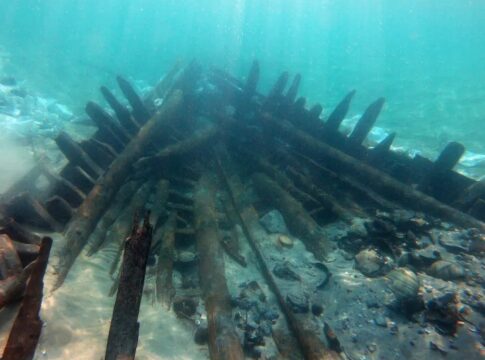
A wooden wreck under Alexandria just turned ancient “pleasure cruising” from a story in dusty texts into something you can measure, map, and argue over plank by plank.
A Luxury Boat in a Harbor That Slipped Beneath the Sea
European Institute for Underwater Archaeology teams located the wreck inside Alexandria’s ancient Portus Magnus, in the zone tied to Antirhodos, a small island that once hosted a prominent Temple of Isis. Earthquakes, tidal waves, and long subsidence helped drag that neighborhood underwater, preserving a strange time capsule: statues, coins, architectural blocks—and now, a big wooden hull. The wreck sat about 160 feet from the temple ruins, close enough to raise uncomfortable questions about how it ended up there.
Size drives the excitement because it pushes this find beyond “just another shipwreck.” Reports describe the vessel at roughly 35 meters by 7 meters, with some coverage distinguishing between preserved remains and a larger reconstructed overall length. Either way, it fits the profile of a boat designed to impress more than to fight: wide enough for stability, built for protected water, and plausibly paired with a central cabin. In modern terms, think of a floating lounge built for processions, politics, and showing off.
Why One Scratched Message in Greek Changes the Whole Story
Greek graffiti on the timbers matters because it does what tourists’ imaginations cannot: it anchors the wreck in a cultural and administrative world. Greek served as a dominant language of elite life in Alexandria after Alexander the Great and through Ptolemaic rule, and it remained deeply embedded into the Roman period. Dating the graffiti to the first half of the first century AD points to a working vessel in early Roman-era Egypt, not a romantic relic from some vague pharaonic “once upon a time.”
The most responsible read is also the most interesting: the graffiti supports an Alexandrian setting without proving who owned the boat, what party happened onboard, or whether the vessel ever touched the Nile proper. Researchers still need to decode markings, compare handwriting styles, and reconcile the text with construction features. That slow, methodical work is the point. Archaeology earns its credibility by resisting the temptation to declare victory on day one, especially when a headline-friendly label like “pleasure barge” is dangling.
Thalamegos: When Ancient Authors Brag, Archaeology Gets a Chance to Audit Them
Ancient writers, including Strabo, described lavish barges used for elite excursions—boats propelled by oars, carrying decorated cabins, and suited for canals and sheltered routes rather than open-sea punishment. Until now, Egypt had the descriptions and the art, but not the physical specimen. That gap has always been a problem because texts exaggerate. Elites embellish. Courts mythologize themselves. A real hull lets scholars test whether those accounts reflected common practice, rare royal spectacle, or literary one-upmanship.
Outside specialists have already added a necessary brake: the wreck looks promising, but the classification requires careful verification. That skepticism aligns with common sense and the conservative instinct to demand evidence before adopting fashionable narratives. A thalamegos is not a vibe; it is a set of features—construction choices, propulsion layout, and context of use—that must fit together. The good news is that the team’s approach emphasizes non-invasive study, including 3D modeling from extensive photographs, which can preserve the wreck while still enabling rigorous analysis.
Pleasure Craft or Sacred Vessel: The Isis Problem No One Can Ignore
The Temple of Isis changes the conversation because Isis worship included waterborne symbolism and processions. Some reporting links the wreck to rituals such as the navigation inside and to routes along the Canopic Channel toward religious destinations like Canopus. That idea has logic: a temple district draws ceremonial traffic, and a big, stable barge makes sense for public display. The wreck’s proximity to the temple ruins creates a narrative gravity that “rich people partying” cannot match.
Still, proximity is not proof. A harbor concentrates vessels of every kind—working boats, official craft, private luxuries, and emergency transports—and disasters scramble them. An earthquake or sudden wave event could have damaged infrastructure, shoved a moored boat into rubble, or stranded it where it did not belong. The ritual hypothesis stays plausible, but it competes with mundane explanations like storm impact, poor maintenance, or simple bad luck at the worst possible moment in a collapsing waterfront district.
What This Wreck Really Exposes: Alexandria’s Fragile Edge and Our Own
The wreck also functions as a warning flare about coastal vulnerability. Alexandria’s shoreline and submerged heritage sit in a region subject to ongoing subsidence, and modern sea-level pressures make preservation harder every year. That reality doesn’t require political theater; it requires sober stewardship. UNESCO-style in-situ preservation rules exist because raising waterlogged wood can destroy it faster than leaving it buried. The uncomfortable implication is that the best way to “save” some treasures is to keep them out of reach.
The public gets the romance, but specialists will chase the receipts: timber analysis, joinery patterns, tool marks, and any cargo or fittings that survived. If the evidence supports a true luxury barge, the find strengthens what ancient sources claimed about wealth and ritual display in Roman Egypt. If it does not, the wreck still matters because it reveals what Alexandria’s harbor actually looked like in working terms. Either result is a win for factual history over lazy legend.
Sources:
Wreck of 2,000-year-old pleasure boat discovered off Egypt’s coast
2,000-year-old shipwreck may be Egyptian ‘pleasure barge’ from last dynasty of pharaohs
Archaeologists find 2000-year-old pleasure barge in Egypt
Divers discover ancient Egyptian party boat