
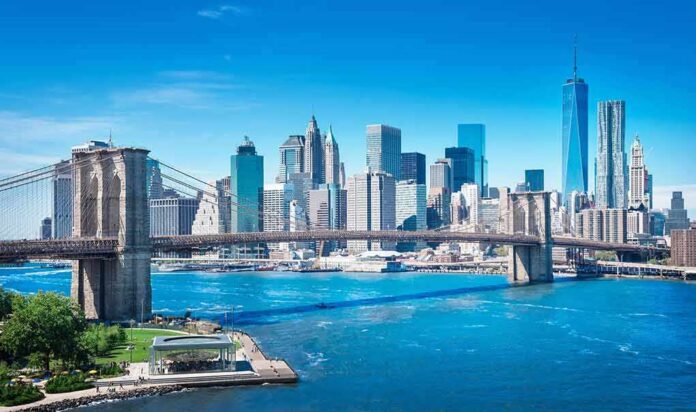
A naked man’s 278‑foot leap from the Brooklyn Bridge ended not in death, but in a rescue that again exposes how America handles public crises as viral spectacle instead of serious warning signs.
Story Snapshot
- A 44-year-old man climbed the Brooklyn Bridge’s north tower, hung flags, stripped naked, and jumped into the East River.
- New York Police Department (NYPD) Harbor Unit officers rescued him from the water, and he was hospitalized in stable condition.
- Police later identified him as Galymzhan Abaildayev and charged him with reckless endangerment, graffiti, public lewdness, trespass, and disorderly conduct.
- The jump shut down a key bridge, fueled viral videos, and raised fresh questions about mental health, security, and trust in government.
A Dramatic Jump, A Miraculous Survival
On Sunday afternoon in New York City, witnesses watched a 44-year-old man climb the north tower of the Brooklyn Bridge on the Manhattan side and attach several flags to the metal structure. Police sources say he then removed all his clothes and stood naked high above the East River as traffic backed up and onlookers filmed with their phones. Officers from the NYPD Emergency Service Unit climbed the tower and tried to talk him down, but he jumped anyway.
After the leap, NYPD Harbor Unit officers rushed to pull him from the river and got him onto a boat within minutes. He was taken to NYC Health + Hospitals Bellevue, where medical staff said his condition was stable despite the long fall. Local reporting describes the jump as roughly 278 feet, a distance that is usually deadly from that height into water. Police and medical responders called his survival remarkable, and earlier scientific studies have noted that only a small number of Brooklyn Bridge jumpers live through such falls.
From Mystery Man to Named Defendant
In the hours right after the incident, many news outlets and social posts simply referred to him as an unnamed 44-year-old man, sharing dramatic video and calling the fall “miraculous.” By Monday, a police statement to NBC News and other outlets identified him as Galymzhan Abaildayev, a Brooklyn resident. That statement said Abaildayev faces charges including reckless endangerment, making graffiti, public lewdness, criminal trespass, and disorderly conduct for climbing the bridge, hanging flags, and jumping into the river below. Some early reports had said no arrest was made, showing how breaking news can shift as officials release more details.
Authorities have not yet explained why Abaildayev climbed the bridge or what message, if any, he meant to send with the flags he planted. Tabloid and social outlets claimed at least one flag was foreign, and some posts mentioned Kazakhstan, but police have not publicly confirmed the flag designs. This gap leaves room for people online to fill in their own stories about motive, politics, or mental health, even though official records so far focus only on the physical act, the rescue, and the criminal charges. The incident remains under investigation, including the reason he chose this risky and public way to act out.
Viral Spectacle, Real Safety Risks
The jump forced a temporary closure of the Brooklyn Bridge, one of the city’s main links between Manhattan and Brooklyn, and added more strain to already congested weekend traffic. Drivers stuck on the bridge watched police climb the tower and saw rescue boats move below, turning a serious safety crisis into real-time content for millions on social media. Many posts mocked the man or called him “unhinged,” while others focused on the height of the fall and the idea that he somehow “beat the odds.” This pattern is common when dramatic events happen in public spaces.
Naked man jumps off 83-meter Brooklyn Bridge and survives
44-year-old climbed the tower, stripped, and leapt into the East River. Rescued in stable condition.
(2 August 2026)#brooklynbridge #newyork #usa #PNC pic.twitter.com/6fZGwfBBdX
— People's news Channel (@peoplesnews2024) August 3, 2026
At a time when many Americans on both the left and the right feel the government is better at theater than problem-solving, scenes like this feed that frustration. People see massive law enforcement response and news helicopters when a naked man jumps from a bridge, yet they watch leaders in Washington argue and stall on deeper issues like mental health care, addiction, and city safety. Research and past cases show that several people try to jump from the Brooklyn Bridge every year, often driven by crisis or despair, but long-term help for those at risk rarely gets the same attention as one shocking video.
Security, Mental Health, and the Deep State Mood
This event also raises basic questions: how did someone with a backpack, multiple flags, and clear distress manage to climb a major landmark in broad daylight. For many citizens who already doubt federal and local leadership, it looks like another sign that the system is better at reacting than preventing. They see billions spent on security and surveillance, yet still watch a man walk past the rules, scale critical infrastructure, and jump while officers can only respond after he is already in danger. That gap is what fuels talk of “elites” and a “deep state” that cannot keep everyday people safe.
Under President Trump and a Republican Congress, national leaders often talk about law and order and strong borders. Still, everyday crises like this bridge jump highlight problems that feel far from solved: untreated mental illness, strained police resources, and aging infrastructure that is hard to secure without turning cities into fortresses. Conservatives worry about chaos in the streets. Liberals worry about harsh tactics used after someone breaks down. Both sides can look at this naked leap and see a government that mostly shows up after the fact, when the cameras are already rolling and a lucky outcome is the only reason the story is not a tragedy.
Sources:
thegatewaypundit.com, timesnownews.com, tmz.com, ndtv.com, instagram.com, nypost.com, worldjournal.com, x.com, aol.com, facebook.com, timesofindia.indiatimes.com, citizen.com, en.wikipedia.org