
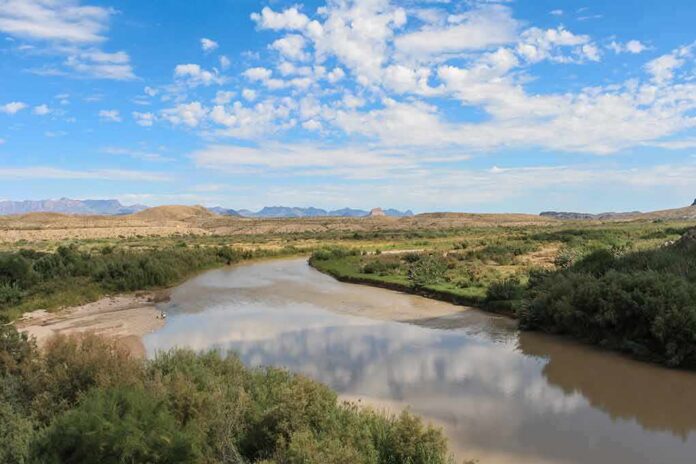
After a surge of U.S. troops, parts of the Rio Grande went quiet as officials pointed to more seizures and fewer crossings in key spots.
Story Snapshot
- Army, Coast Guard, and Border Patrol expanded operations in the Rio Grande Valley, and officials described a calmer river corridor.
- Border Patrol leaders cited drug seizures, apprehensions, and reduced traffic as signs the push is working in targeted areas.
- Crossings had already fallen after 2024 asylum limits and later suspensions, complicating claims that troops alone drove the decline.
- Large groups still crossed and were apprehended, showing enforcement remains active despite quieter scenes.
What changed on the river
Military.com reported that soldiers took up posts in Roma, Texas, as the Army expanded its presence to about 8,000 troops along the border. The Coast Guard added more personnel to river patrols, and Texas law enforcement increased activity. U.S. officials told reporters that parts of the Rio Grande looked calmer during the embed. They linked the troop surge to cartel threats and recent violence, and said the show of force aimed to deter smugglers and guide crossings toward enforcement choke points.
U.S. officials also described cooperation with Mexico. The reporting said Mexico sent about 500 National Guard and military officers to Tamaulipas to target traffickers. Joint efforts can slow crossings on both banks when patrols are synchronized. That kind of coordination matters on a river where smugglers watch for gaps. But the media access was limited, and officials did not release full deployment details, so the public picture still relies on brief tours and selected briefings.
Why officials say the push is working
Joel Garcia, the acting deputy chief patrol agent for the Rio Grande Valley, said his team had indicators of success. He pointed to drug seizures, the number of apprehensions, and reduced traffic in some zones. Those are common enforcement markers. They can show that patrols are intercepting more loads and moving people toward capture points. They can also reflect more personnel and patrol hours rather than less smuggling overall. Officials did not publish matching totals or time frames with the claims.
Border Patrol releases show that enforcement capacity remained high. In one five-day span, agents caught five large groups totaling 648 people in Hidalgo and Starr Counties. The Rio Grande City station encountered 520 of those migrants. These cases show that even with a calmer stretch of river, crossing attempts continued. They also suggest that smugglers still mass people to overwhelm spots, while agents counter by concentrating resources where traffic flows.
Violence, triggers, and unanswered details
Security concerns escalated after a violent exchange on the river. The U.S. Coast Guard reported that personnel took gunfire from the Mexican side on September 26 and returned fire during an operation. Military officials cited that incident when moving more troops into the valley. NewsNation and Military.com reported that roughly 500 additional service members were shifted, but officials did not publicly confirm exact numbers or the mission’s duration at the time, creating gaps in public accountability.
Those gaps matter because Americans across the spectrum doubt that Washington levels with them. A calmer river scene can look like progress. But without clear figures, it is hard to separate the effect of troops from other forces. The same period saw earlier policy shifts and Mexican crackdowns that many analysts credit for a sharp fall in crossings. That makes it risky to claim a single cause for the change and feeds the sense that leaders simplify complex problems for headlines.
Did troops drive the drop, or did policy?
Multiple outlets and institutions tie the decline to policy changes that started before the latest military moves. Analysts noted that the United States narrowed asylum access in 2024 and later suspended it in some periods. Mexico also intensified enforcement by busing migrants south and tightening controls. Together, those moves cut crossings before and alongside the troop surge, according to independent reporting and research groups that track border trends over time.
Pew Research Center reported that migrant encounters fell to multi-decade lows in early 2026. It linked those levels to policy changes on both sides of the border. That trend does not rule out an added effect from troops. It does show why claims need careful data. If seizures rise when staffing rises, that can mean better enforcement. It can also mean smugglers are sending more loads, or that agents now catch a larger share of the same flow.
What would prove cause and effect
Proving the military impact would take sector-level data before and after each deployment. That includes daily encounters, apprehensions, seizures, patrol hours, and response times. It also needs comparisons with sectors that did not get similar troop boosts, and controls for policy shifts and weather. Without that, the public sees a quiet river one day and big groups the next. That split view fuels frustration that the government manages the message more than the mission.
Sources:
military.com, cbp.gov, wola.org