
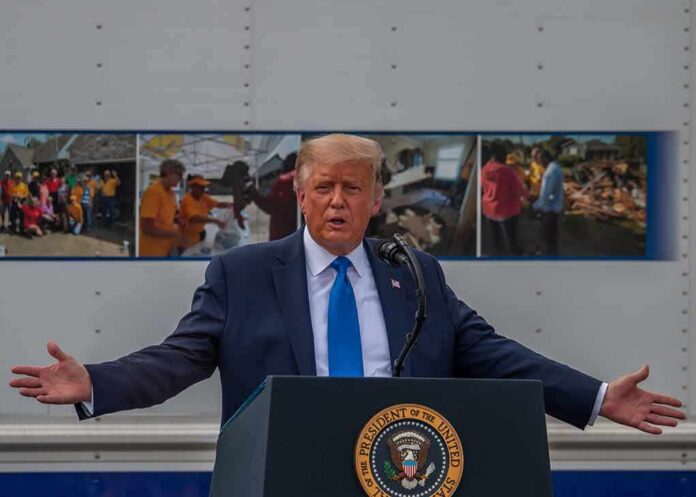
President Trump snapped at a New York Times reporter who asked whether he was holding off on new Iran strikes until after the midterm elections, refusing to say what comes next.
Quick Take
- Trump told reporters at Joint Base Andrews that “something” involving Iran will happen “fairly soon” but would not say what.
- He insisted the United States is “not negotiating with” Iran, even as the White House has described ongoing diplomatic options.
- The New York Times reported U.S. and Israeli militaries drew up specific plans for renewed strikes after the November 3 election.
- The same reporting admits Trump has repeatedly vetoed plans for new combat operations against Iran this year.
- Secretary of State Marco Rubio says no final decision on new strikes has been made.
Trump Refuses To Tip His Hand On Iran
Trump boarded Air Force One at Joint Base Andrews on October 22 and faced a question from a New York Times reporter tying possible Iran action to the election calendar. He shot back that “most people seem to think it’s after the election,” without confirming or denying that timeline himself. He added only that “something one way or another will happen, fairly soon”.
Conservatives who have watched this president handle hostile press for a decade know the drill. Reporters try to bait him into confirming classified military timing, and he refuses to hand enemies a battle plan. That is not evasiveness. That is basic operational security, something previous administrations too often ignored at America’s expense.
What The New York Times Actually Reported
One day before Trump’s remarks, the New York Times reported that U.S. and Israeli militaries had developed specific plans for renewed strikes against Iran after the midterms, citing unnamed officials and people briefed on the discussions. Those reported plans reportedly target Iranian energy sites, nuclear facilities, and missile and drone arsenals. The Pentagon has drafted options for roughly three days of intense strikes on similar targets, according to earlier Times reporting.
That same reporting includes an important caveat conservatives should not ignore: it is “far from certain” Trump will approve fresh strikes, because he has repeatedly vetoed plans for a return to major combat operations against Iran throughout the year. A New York Times podcast likewise noted that while both militaries have stepped up exercises, it remains unclear whether Washington and Jerusalem will actually follow through.
Mixed Signals Or Smart Strategy?
Press Secretary Karoline Leavitt has said airstrikes remain “one of the many, many options that are on the table,” while stressing diplomacy is still the administration’s first choice. Rubio told reporters Trump has not decided on new strikes amid stalled peace talks. Critics will call this contradictory. A more honest read is that Trump is deliberately keeping Tehran guessing, a tactic that forced Iran to the table once before and rattles a regime that thrives on predictability.
Skeptics on the left are already pushing a narrative that any post-election action would be politically timed, pointing to Trump’s own comment about “after the election.” But connecting military readiness to political motive requires real evidence, not just suspicion. Presidents have kept contingency plans ready for generations without ever pulling the trigger, and the Pentagon routinely updates such plans as conditions change on the ground.
Why This Matters For American Strength
Iran’s regime has spent years funding terror proxies, threatening the Strait of Hormuz, and racing toward nuclear capability. A president willing to keep “very strong” military options on the table, as Trump described them earlier this year, sends a clearer deterrent signal than one who telegraphs every move. Weakness invites aggression. Unpredictability, used wisely, protects American lives and allies like Israel without requiring troops to actually deploy.
BREAKING: Israeli Prime Minister Benjamin Netanyahu is pressing President Trump to launch new strikes on Iran immediately after Tuesday’s US midterm elections, according to Axios.
The two leaders spoke by phone on Saturday. Israeli sources described the call as “tough,” while US…
— Middle East Prime Report (@MiddleEastPrime) November 1, 2026
None of this means Trump has secretly ordered strikes, and nothing in the public record proves a final decision has been made. What it does show is a president unwilling to let a hostile press corps dictate the terms of national security debate. That distinction matters, especially heading into an election where Iran policy will be scrutinized by voters on both sides.
Sources:
nytimes.com, timesofisrael.com, nationalsecurityjournal.org