

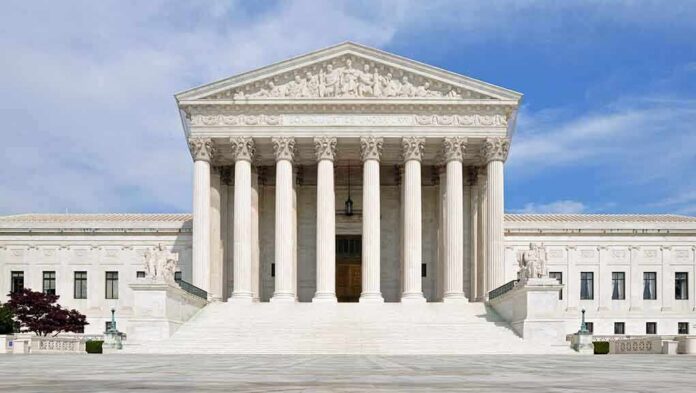
House Republicans are pushing a constitutional amendment that would permanently freeze the Supreme Court at nine justices, just weeks after a senior Democrat said thirteen would be “a pretty good number.”
Quick Take
- A Republican-led House panel advanced a constitutional amendment locking the Supreme Court at nine justices.
- Rep. Dusty Johnson’s “Keep the Nine” bill has been reintroduced across three Congresses without passing.
- Democratic Rep. James Clyburn publicly called for expanding the Court to thirteen justices, calling it “a baker’s dozen.”
- The Court’s size changed seven times in American history before settling at nine in 1869.
House Panel Moves on Nine-Justice Amendment
A Republican-led House panel advanced a proposed constitutional amendment that would permanently cap the Supreme Court at nine justices, citing fears that Democrats could someday try to “pack the court” with extra seats. The measure, H.J.Res.1, states plainly that the Court “shall be composed of nine justices consisting of one chief justice and eight associate justices”.
Rep. Dusty Johnson, a South Dakota Republican, has led this fight since 2021. He reintroduced his “Keep the Nine” amendment again this year, saying it would stop either party from stacking the Court to win rulings it wants. Democrats have blocked similar resolutions before, with 218 House Democrats voting down an earlier version.
Clyburn’s Call for Thirteen Justices Fuels the Fight
Rep. James Clyburn, a South Carolina Democrat, gave Republicans fresh ammunition when he said Congress “ought to expand” the Court. “Thirteen is a pretty good number,” Clyburn said. “A baker’s dozen would be a good number to have on the court”. He argued the current justices don’t follow what he called the Constitution’s civil rights guarantees.
Clyburn’s comments echo a 2021 bill from Senate and House Democrats that would have added four seats, bringing the total to thirteen. That effort stalled after then-Speaker Nancy Pelosi said she had no plans to bring it to the floor. Commentators now argue Clyburn’s remarks show court expansion has become a live option again for Democrats heading into 2028.
A Number With a Long, Shifting History
Nine is not written into the Constitution. Article III leaves the Court’s size entirely up to Congress, and lawmakers changed it seven times between 1801 and 1869, moving between five and ten seats before settling on nine. The number has held steady since then, making it one of the longest-running unwritten rules in American government.
The most famous attempt to break that rule came in 1937, when President Franklin Roosevelt proposed adding up to six new justices after the Court struck down several New Deal programs. Congress rejected the plan, and “court packing” became a lasting political insult rather than a policy playbook. Today’s fight over locking in nine justices is, in part, an attempt to make sure that history never repeats.
What This Means for Voters on Both Sides
Neither party has the votes right now to actually change the Court’s size or lock it in permanently. A constitutional amendment needs two-thirds support in both the House and Senate, plus ratification by 38 states, a bar no recent Congress has cleared. That reality turns this fight into more of a messaging battle than an immediate legal shift, though it signals how seriously both sides now treat the Court’s makeup as fair game.
Democrats renewed calls ahead of the midterms to expand the U.S. Supreme Court, while House Republicans are considering a constitutional amendment this week that proposes to cap the number of justices at nine, @Ashley__Murray reports. https://t.co/BcNqKRIoQC pic.twitter.com/NqeDa1I9CR
— Kathie Obradovich (@KObradovich) September 1, 2026
For voters frustrated with Washington gridlock, the episode captures a familiar pattern. Republicans warn Democrats could pack the Court if given the chance. Democrats warn the current Court already leans too far right. Both sides claim they’re protecting the Constitution, while neither has enough votes to change anything soon, leaving the underlying distrust in the system unresolved.
Sources:
congress.gov, young.senate.gov, constitutioncenter.org, docs.house.gov, foxnews.com, scholarship.law.stjohns.edu, thehill.com