

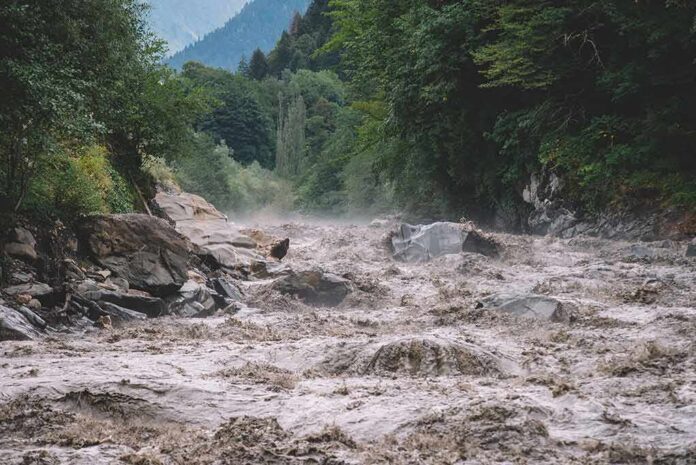
A sudden ice avalanche likely triggered a deadly flash flood on the Nepal–Tibet border, washing away villages and leaving hundreds missing, according to early expert analyses.
Story Highlights
- Preliminary satellite and seismic reviews point to a glacier-related ice avalanche as the trigger.
- Officials report more than 150 dead and hundreds missing, including foreign tourists.
- Rescue teams race to reach cut-off valleys as roads, bridges, and power sites lie in ruins.
- Scientists warn these high-mountain flood disasters are part of a wider, rising regional risk.
What we know about the sudden flood and its cause
Officials in Nepal said a fast-moving wall of water and debris tore through border valleys on Wednesday, destroying homes and key crossings. Early reviews by glaciologists point to an ice avalanche that broke from a glacier and crashed into the valley, releasing a destructive surge downstream. The United States Geological Survey recorded a tremor that was later linked to the collapse itself, not to a separate quake, backing the avalanche-trigger theory. Rescue crews reported widespread damage across roads, bridges, and power projects.
Police and aid groups reported a rising death toll and hundreds of missing people as teams pushed into remote areas. Newsrooms cited at least 157 to more than 160 confirmed deaths in Nepal, with many more unaccounted for, including foreign tourists. Authorities also tracked losses across the border in Tibet, with three dead and hundreds missing, based on Chinese state reporting. Officials warned those numbers could change as crews clear landslides and restore communications.
Why the Himalaya faces repeat disasters like this
Scientists say the Himalaya is seeing more dangerous flood chains that start with ice and rock falls, lake failures, or sudden releases of stored water. Reviews count hundreds of recorded glacial lake outburst floods across the wider region over the past two centuries, with thousands of lives lost. Peer-reviewed work shows the risk is rising as glaciers shrink and lakes grow, while roads, hydropower sites, and settlements expand deeper into hazard corridors. That mix turns a remote slope failure into a river of debris hitting towns downstream.
Regional research details how these floods can match the force of major monsoon rivers, even far downstream. Modeling shows a one-hundred-year outburst flood can move water at rates similar to big lowland rivers, overwhelming bridges and embankments. Institutions in Kathmandu have warned for years that end-moraine dams and shrinking ice increase the odds of sudden failures. Their assessments call for better mapping, monitoring, and evacuation plans for valleys like the ones hit this week.
Rescue pressures and the early-warning gap
Nepal’s responders are clearing blocked mountain roads, flying in teams by helicopter when weather allows, and trying to reach pockets of survivors. Damaged power and communications slow the search and limit alerts downstream. International Centre for Integrated Mountain Development experts say compound events, like an ice avalanche striking a glacial lake or river, are hard to spot in time without constant satellite eyes and on-site sensors. The United States Geological Survey reading tied to the collapse hints at the value of seismic data in near-real-time alerts.
Devastating flash floods and heavy landslides tear through the Nepal-China Tibet border region on August 26, leaving entire communities ruined and hundreds of people including tourists missing. What are your thoughts?#Better9jaBlog pic.twitter.com/5v2hZ6q5FP
— Better9jablog (@Better9jablog) August 27, 2026
Local leaders across the region now face a familiar dilemma. People need roads, power, and jobs. But each new asset in a narrow valley can become a target for the next debris surge. Researchers press for practical steps: keep critical buildings out of flood paths, add overflow channels at risky lakes, strengthen cross-border data sharing, and drill evacuation routes each season. These steps cost less than rebuilding towns after another wall of water.
Why this matters far beyond Nepal
Americans who watched bridges fall and grids fail during storms will see a pattern here. When basic safeguards lag, nature finds the weak spot. The damage then hits workers, small businesses, and families first. The lesson is not partisan. It is about doing the unglamorous work: mapping risk, funding maintenance, and fixing what officials call “known problems” before they become national emergencies. The Himalayan disaster underscores that prevention beats cleanup, every time.
Sources:
nytimes.com, thestar.com.my, reuters.com, theguardian.com, thevoice.news, bbc.com, indiatoday.in, aljazeera.com, mhewc.org, lib.icimod.org, icimod.org, pnas.org, unisdr.org