

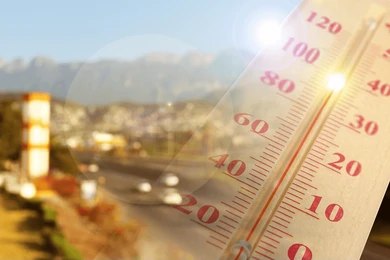
The most dangerous part of this holiday heat wave is not the triple-digit highs—it is the way the heat will not let your body recover, day or night.
Story Snapshot
- Extreme heat alerts now stretch across 31 states, covering about 90 million Americans under direct warnings.
- Heat index values are forecast to reach up to 115 degrees Fahrenheit, with air feeling closer to a steam bath than summer weather.
- Nighttime temperatures will stay stuck in the 70s, removing the normal window when the human body cools and repairs.
- This event fits a clear, decades-long trend of more frequent, longer, and more intense U.S. heat waves.
Extreme heat warnings blanket the eastern United States
The National Weather Service issued extreme heat warnings, watches, and advisories across 31 states, reaching from the Midwest to the East Coast ahead of the July Fourth holiday. Forecasters estimate about 90 million people are directly under these alerts, with as many as 230 million likely to feel the worst of the heat as the dome spreads. This is not a typical hot spell. It is a coordinated, nationwide warning system telling tens of millions that conditions can quickly become life-threatening.
The heat index, which combines temperature and humidity to estimate how the air feels to the human body, is expected to push well above 100 degrees in many cities and up toward 115 degrees at the peak. A National Weather Service forecaster, Bryan Putnam, explained that humidity will drive the “feels like” temperature well into the 100s as moisture in the air blocks sweat from evaporating, the body’s main cooling method. In central Pennsylvania, forecasts show temperatures near or above 100 degrees with humidity making it feel closer to 110 degrees.
Humidity turns normal heat into a direct threat to the human body
Most people focus on the air temperature reading on the thermometer. The human body cares more about how quickly it can dump heat into the environment. Wet-bulb temperature is the key number scientists use to track this. It combines heat and humidity and measures the lowest temperature that evaporation can reach. Recent research from Pennsylvania State University shows humans start to fail at wet-bulb temperatures around 31 degrees Celsius, lower than the old 35-degree estimate. At that point, even a healthy adult sitting in the shade with water can overheat.
Official heat alerts for this event rely on the heat index, not wet-bulb temperature, so the National Weather Service has not publicly shared wet-bulb numbers for the days around July Fourth. That does not mean they are safe; it means the public risk message uses a simpler metric that the average person recognizes. From a common-sense, conservative view, this is where transparency needs to catch up with science. If wet-bulb thresholds now define when a human body cannot survive, the agencies we fund should explain how close our neighborhoods are to those lines, not just tell us it “feels like” 105.
Heat that does not let up overnight is what pushes people over the edge
One of the most serious features of this heat wave is the lack of overnight relief. Forecasts show nighttime lows only dropping into the 70s across large parts of the eastern United States. Excessive heat warnings are extended through July 4 for multiple counties in Pennsylvania because the heat index is expected to stay above 75 at night for long periods. The body normally cools down in the dark hours. When the air stays hot and humid, heart rate remains elevated, sleep quality tanks, and each day starts with a deficit.
History shows what happens when that pattern persists. The National Weather Service notes that in the 1980 heat wave more than 1,250 people died, while the 1995 Chicago heat wave killed more than 700 people in just a few days. Many of those victims were older adults, poor residents, or people living alone without reliable air conditioning. Those numbers are not scare tactics. They are proof that a few degrees of trapped heat at night can change the death count in a city far faster than most storms.
This heat wave is part of a larger shift, not a random fluke
Studies of United States heat waves show a clear long-term rise in both the number of hot days and the length of heat seasons, especially in the Southeast and Great Plains. Research from the Union of Concerned Scientists and Climate Central finds that extreme heat events have gone from a couple of times per year in the 1960s to about ten times per year in many cities between 2010 and 2020. That means what used to be rare is now normal. The current heat dome over the eastern two-thirds of the country fits this pattern of more common, broad, and intense events.
A dangerous, building heat wave is taking over today, Tuesday, June 30, across the central and eastern US. Highs in the 90s to low 100s will combine with heavy humidity to drive heat indices to a brutal 105-115°F. Take it easy out there. #HeatWave #Weather
— YallBot (@OfficialYallbot) June 30, 2026
From a conservative standpoint, this raises two separate questions. First, how much of this trend is driven by global climate change versus land use, city design, and energy policy? Second, are the institutions warning us about heat doing as much to fix vulnerabilities as they do to sound alarms? Agencies like the Environmental Protection Agency and the Centers for Disease Control and Prevention now openly state that multiday heat waves are expected to be longer, affect more of the country, and become more severe in the coming decades. Yet there is still no federal guarantee of open, free cooling centers for every vulnerable resident who receives these warnings.
Personal responsibility matters, but so does honest, apolitical risk communication
The National Weather Service heat guidance stresses simple, practical steps: slow down outdoor activity, stay out of direct sun, drink plenty of water, avoid alcohol, and seek indoor cooling when possible. That message aligns well with common sense and traditional American ideas of personal responsibility. However, the science on wet-bulb temperature and the growing number of extreme heat days show the stakes are higher than many public advisories admit. A person cannot just “tough out” heat that physically blocks their body’s cooling systems.
Media coverage now leans hard into climate narratives and record-breaking language. That can help people take danger seriously. It can also fuel skepticism if reporters hype records that later fail to verify, or if they ignore the everyday tradeoffs families face about paying the power bill, running air conditioning, or finding a public place to cool down. For this 2026 heat wave, there is no credible evidence of “engineered” weather, and serious outlets and scientific groups openly reject that theory. But there is still a gap between advanced science, basic warnings, and on-the-ground protection. Closing that gap with clear, non-political facts and real support for at-risk people is the work that remains after this heat dome breaks.
Sources:
insiderpaper.com, usatoday.com, washingtontimes.com, npr.org, weather.gov, reddit.com, climatecheck.com, sydney.edu.au, pmc.ncbi.nlm.nih.gov, nature.com, c2es.org