
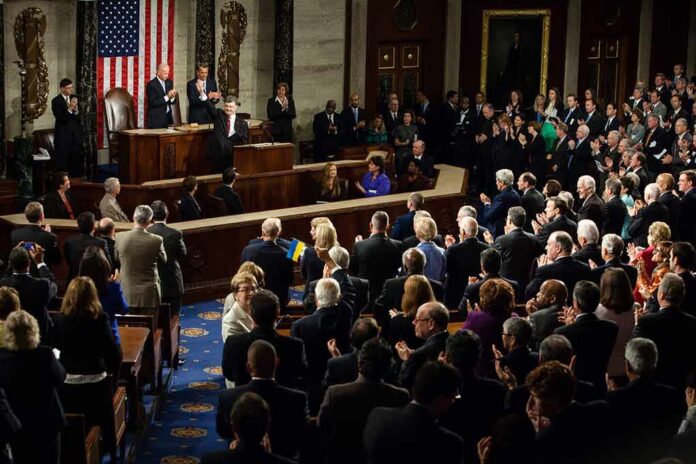
In a lopsided 352–72 vote, the House approved a plan to lock a new Justice Department fraud unit into law, giving President Trump a clear win on cracking down on waste of taxpayer money.
Story Snapshot
- The House passed H.R. 9576 to establish a National Fraud Enforcement Division at the Department of Justice (DOJ).
- The bill creates a Senate-confirmed leader and makes the division permanent in law.
- House materials link the plan to $30 million in funding for enforcement capacity.
- The measure drew broad bipartisan support but has not yet cleared the Senate.
What The House Passed And Why It Matters
House lawmakers voted 352–72 to pass H.R. 9576, the National Fraud Enforcement Division Act of 2026. The bill states, “There is hereby established a National Fraud Enforcement Division within the Department of Justice.” The division’s mission is to investigate and prosecute fraud involving federal dollars and taxpayer-funded programs. The vote signals broad support for tougher enforcement on misuse of public money in programs that many families rely on every day.
The legislation also creates a new leadership post. The text authorizes an Assistant Attorney General who must be appointed by the President and confirmed by the Senate to run the division. That puts a named, accountable official in charge and sets clear lines of authority for cases the unit will take on. Supporters say this structure will speed coordination across criminal and civil enforcement inside the Department of Justice.
How This Fits The Bigger Anti-Fraud Push
House committees advanced the measure through standard procedure before the floor vote, underscoring its status as a priority item. Floor records show action on September 16, 2026, when the House agreed to final passage by roll call. The Rules Committee packaged the bill for debate, reflecting leadership’s intent to move quickly. That route is typical when both parties see a policy gain in protecting limited public funds from organized fraud schemes.
Money and manpower drive results, so the funding note matters. House appropriators publicly tied the division to a $30 million line to build staff and tools. That funding links the legal change to real capacity, like more prosecutors, data analysts, and field coordination. Without resources, new boxes on an org chart often fail. With resources, a unit can bring complex cases that local offices might not have time or expertise to handle.
Where Support And Resistance Came From
The vote margin shows wide but not unanimous support. All Republicans backed the bill, and a large group of Democrats joined them, yielding the 352–72 total. That kind of tally is rare in today’s Congress. It reflects a shared worry that fraud drains money from programs meant to help veterans, seniors, patients, workers, and small businesses. Some Democrats still voted no, signaling concerns about scope, overlap, or priorities, but the center of gravity favored action.
President Trump benefits from the result because it advances his administration’s focus on fraud and program integrity. The House move also sends a message to federal agencies and contractors that oversight is tightening. Backers argue a single division can close gaps across tax, health care, trade, and other fraud areas by pooling expertise. Critics often warn that new units can duplicate work done by existing Justice Department sections or United States Attorneys’ Offices. The text positions this division to coordinate rather than replace.
What Comes Next And What To Watch
The bill still needs Senate approval and the President’s signature to become law. Until that happens, the House vote stands as a strong signal but not a final outcome. If enacted, the new Assistant Attorney General slot would require Senate confirmation, adding a second layer of accountability. Companies and agencies that receive federal funds should expect more audits, data sweeps, and case referrals aimed at clawing back misspent dollars.
BREAKING: The House just PASSED legislation to codify into law President Trump's National Fraud Enforcement Division within DOJ
Final vote: 352-72
Once approved by the Senate and signed, this bill will LEGALLY REQUIRE Trump's established anti- Fraud pic.twitter.com/PlPZRDyPjw
— Sergeant News Network (@SGTnewsNetworks) September 17, 2026
For many readers across the political spectrum, the core theme is simple: every dollar lost to fraud is a dollar not serving real people. Conservatives see a step toward cutting waste. Liberals see protection for safety-net programs and honest providers. Both sides share anger at systems that reward insiders while working families pay the bill. The House just voted to push the system in a direction most Americans say they want—stronger guardrails and real consequences for cheating taxpayers.
Sources:
facebook.com, hamadeh.house.gov, congress.gov, hindustantimes.com, docs.house.gov, quiverquant.com, govinfo.gov, clerk.house.gov, appropriations.house.gov