
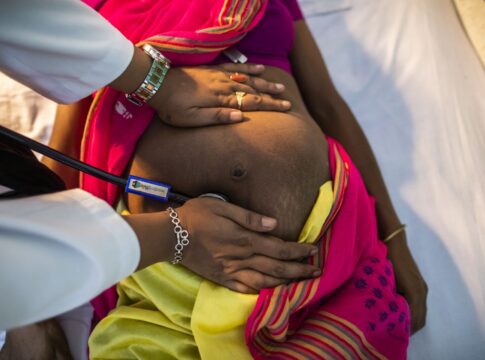
Human childbirth hurts and kills for one simple reason: evolution built us to walk upright and think big, not to deliver big-headed babies easily.
The tight squeeze that no amount of optimism can talk away
The human pelvis is a compromise: narrow enough for efficient upright walking, but just wide enough—barely—for a newborn whose head must house an unusually large brain. That mismatch turns labor into a high-stakes mechanical process. The baby doesn’t simply slide out; the head and shoulders must navigate bone, soft tissue, and angles that leave little margin for error. When that choreography fails, complications like obstructed labor and hemorrhage become life-threatening fast.
Other mammals deliver with less drama because their newborn proportions and pelvic shapes align more comfortably. Humans chose a different bargain: big brains, long childhoods, and the ability to cover ground. The cost lands in the delivery room. The most telling clue is how “unfinished” human babies are at birth compared with other primates. Nature didn’t make birth easy; it made birth possible—then left culture, family, and medicine to manage the danger.
Why humans give birth “early,” and why it still isn’t enough
People sometimes assume evolution always fixes a problem if it’s severe enough. Childbirth exposes the limits of that faith. Humans partially escape the pelvis-head conflict by giving birth earlier than you’d expect for brain development, producing an altricial newborn that still needs years of care. Even then, the baby typically rotates during birth, a sign that the route out is not a straight hallway but a twisting passage with hard corners and tight clearances.
That rotation is not a cute biological trick; it is a symptom of constraint. A baby’s head can’t enter and exit the pelvis in the same orientation because the bony dimensions change along the canal. This helps explain why labor can be prolonged and exhausting, and why a stalled labor can become a crisis. The body’s design runs close to its tolerances, so small disadvantages—size, position, fatigue, blood pressure—can tip events quickly.
Maternal mortality fell for a century, then reality got complicated
For most of human history, birth was a leading cause of death for women. Modern declines came from unglamorous breakthroughs: sanitation, antibiotics, safer surgery, blood transfusion, and organized obstetric care. Globally, maternal mortality dropped steeply in the 20th century and continued to fall in the early 2000s. From 2000 to 2023, the global maternal mortality ratio declined to about 223 deaths per 100,000 live births.
That progress still leaves an uncomfortable headline: roughly 260,000 maternal deaths occurred in 2023, with the overwhelming majority in low- and lower-middle-income countries. Sub-Saharan Africa carries the heaviest burden, and conflict or fragile governance multiplies risk. These are not mysteries of biology; they are failures of stability and logistics—skilled staff unavailable, clinics too far, transport unreliable, blood supplies limited, and emergencies arriving late when minutes matter.
Is childbirth getting harder in rich countries, or are we just counting better?
In high-income settings, the question “getting harder” splits into two truths. First, measurement changed. The United States expanded how it identifies maternal deaths in ways that can raise reported rates without a sudden biological shift. Second, the people giving birth changed. Older maternal age, obesity, chronic hypertension, and diabetes increase risk, and they are more common now. Those factors make pregnancy less forgiving even when hospitals are nearby.
System design decides whether those risks translate into deaths. International comparisons show the U.S. as an outlier among peer countries, with maternal mortality far higher than places that run more integrated maternity care. Common sense says a fragmented system produces fragmented responsibility: inconsistent prenatal follow-up, uneven access to specialists, and gaps after delivery when complications like blood pressure crises can strike. Biology loads the gun; systems and habits determine whether it fires.
The conservative, practical takeaway: prevention beats heroics
Public health messaging often drifts into slogans, but childbirth rewards plain, conservative logic: do the basics reliably, and you save lives. Skilled attendants, timely referral, and postpartum follow-up prevent most deaths. That is not ideology; it is operational competence. The same principle applies at home: strong families and local community support matter because new mothers need practical help—transportation, childcare, nutrition, and someone noticing when symptoms turn dangerous.
Technology can assist, but it cannot substitute for accountability. A cesarean can be life-saving; it also carries risks when overused or poorly managed. The goal is not to chase “natural” at all costs or to treat birth like a scheduled procedure. The goal is readiness: identify high-risk pregnancies early, manage weight and blood pressure realistically, and keep continuity of care after discharge. That is how you respect life without indulging in fantasies.
Childbirth will never become easy in the way people mean it—painless, predictable, risk-free—because the underlying anatomy reflects a deep evolutionary trade-off. What can change, and quickly, is whether that difficulty turns deadly. The countries and communities that win treat birth as a serious event, not a vibe: they staff it, fund it, measure it honestly, and follow mothers after delivery. The open question is whether high-income systems will relearn that discipline before the numbers force it.
Sources:
List of countries by maternal mortality ratio
[PMC] Maternal mortality in the UK and USA: are there lessons to learn?
Maternal Mortality and Maternity Care in the United States Compared to 10 Other Developed Countries
Insights on the U.S. Maternal Mortality Crisis: An International Comparison
Maternal mortality ratio (modeled estimate, per 100,000 live births)